
How to Become an SAP Consultant in 2026: A Practical Roadmap for Beginners
Every year, thousands of college graduates and ambitious working professionals across India, North America, the Middle East, and Europe look at the enterprise software market and ask the same pivotal question: "How do I break into high-paying SAP consulting without prior enterprise implementation experience?"
The landscape of 2026 is uniquely advantageous for newcomers. With SAP's official 2027 maintenance deadline for legacy ERP Central Component (ECC 6.0) rapidly approaching, over 40,000 global enterprises are actively modernizing their core operational backbones to SAP S/4HANA. Major system integrators—including Accenture, Deloitte, PwC, EY, TCS, Infosys, Capgemini, and Wipro—are aggressively competing for functional and technical talent capable of configuring, migrating, and supporting these mission-critical systems.
However, breaking into the field requires more than watching generic YouTube videos or memorizing transaction code definitions. It requires an organized, battle-tested learning roadmap that builds demonstrable, project-grade configuration skills.
In this mentor-led guide, we provide a structured 90-day actionable roadmap designed to take you from total ERP novice to a confident, job-ready SAP consultant in 2026.
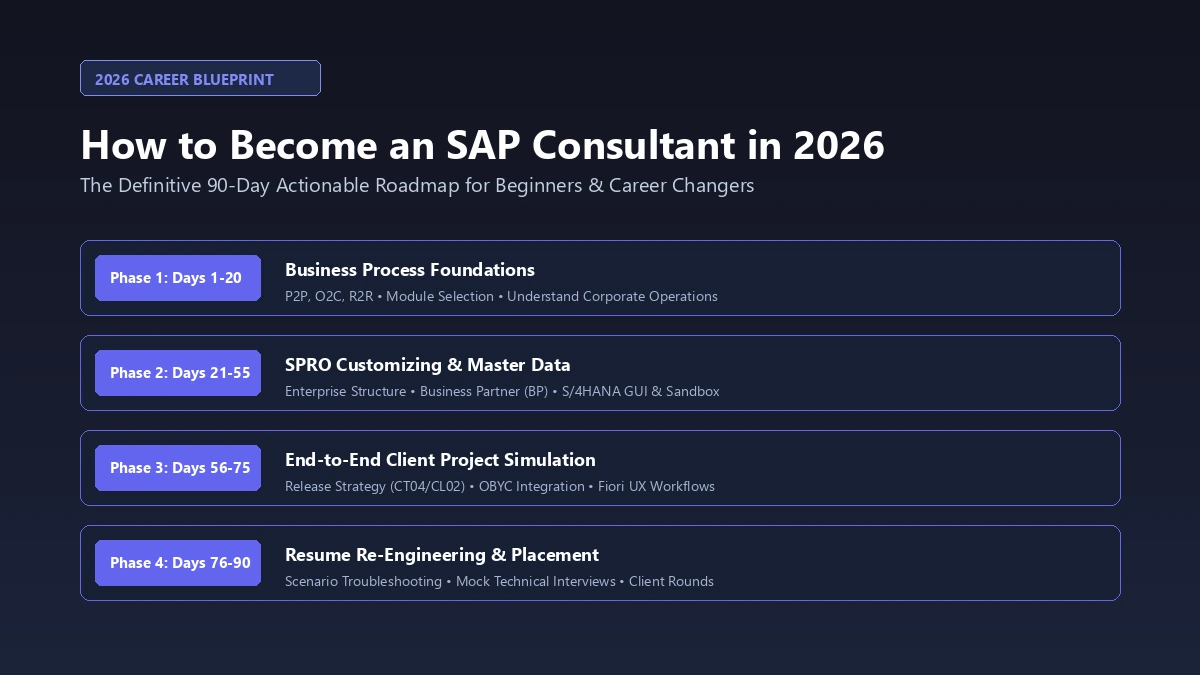
The 4-Phase 90-Day Chronological Roadmap
Launching an SAP career follows a disciplined, four-phase trajectory:
[Phase 1: Days 1–20]   ──> Business Process Literacy & Module Selection
                               │
[Phase 2: Days 21–55]  ──> Hands-On SPRO Customizing & Master Data Mastery
                               │
[Phase 3: Days 56–75]  ──> End-to-End Client Implementation Simulation
                               │
[Phase 4: Days 76–90]  ──> Resume Re-Engineering, Mock Scenarios & Placement
Phase 1: Days 1 to 20 — Business Process Literacy & Module Selection
The single biggest mistake novices make is opening SAP GUI on Day 1 and trying to memorize hundreds of screens.
SAP is not an isolated coding software; it is a business automation engine. If you do not understand what a purchase requisition, general ledger, or depreciation run represents in real-world commerce, you cannot configure it in software.
Step 1.1: Understand How a Corporation Functions
Before touching software, study real business operations:
- Procure-to-Pay (P2P): How companies purchase raw materials, negotiate vendor contracts, receive physical deliveries, and settle accounts payable.
- Order-to-Cash (O2C): How companies receive customer orders, schedule manufacturing, ship goods, and collect receivables.
- Record-to-Report (R2R): How companies reconcile ledgers, calculate balance sheets, and close monthly financial books.
Step 1.2: Commit to ONE Core Module Based on Your Background
Do not attempt to learn three modules at once. Choose the single module that leverages your natural academic or professional strengths:
- Commerce / Accounting / CA / Finance: Choose SAP FI (Financial Accounting).
- Engineering / Logistics / Warehouse / SCM / Operations: Choose SAP MM (Materials Management).
- Sales / Marketing / Commercial Operations: Choose SAP SD (Sales & Distribution).
- Computer Science / Programming / Database Admin: Choose SAP HANA Modeling or ABAP Cloud.
Phase 2: Days 21 to 55 — Hands-On SPRO Customizing & Master Data
Once your module is selected, transition into hands-on configuration on an active SAP S/4HANA sandbox server. Reading PDF guides or watching passive lecture slides will not make you a consultant; building systems with your own keyboard will.
Step 2.1: Master the Enterprise Organizational Structure
In transaction SPRO (SAP Project Reference Object), configure a complete corporate enterprise structure from scratch:
- Define Company Codes, Plants, Storage Locations, Purchasing Organizations, and Cost Centers.
- Assign operational plants to company codes and purchasing organizations.
- Understand how data flows across organizational boundaries.
Step 2.2: Master Modern Master Data Governance
In modern SAP S/4HANA, legacy customer and vendor tables are unified under the Business Partner (BP) concept:
- Configure Business Partner roles:
FLVN00(Financial Supplier),FLVN01(Purchasing Supplier),FLCU00(Company Code Customer), andFLCU01(Sales Customer). - Maintain Material Master parameters across Accounting, Purchasing, MRP, and Storage views (
MM01). - Practice Customer-Vendor Integration (CVI) synchronization.
Step 2.3: Core Transactional Workflows
Execute the complete transactional lifecycle repeatedly until navigation becomes second nature:
- For MM:
ME51N(PR) $\rightarrow$ME21N(PO) $\rightarrow$MIGO(Goods Receipt) $\rightarrow$MIRO(Invoice Verification). - For FI:
FS00(GL Master) $\rightarrow$FB50(GL Posting) $\rightarrow$FB60(Vendor Invoice) $\rightarrow$F110(Payment Program).
Phase 3: Days 56 to 75 — End-to-End Client Implementation Simulation
Senior consultants are not tested on basic definitions during interviews; they are tested on real-time troubleshooting and business scenarios.
During Phase 3, build a simulated real-world client implementation:
1. Build an Approval Release Strategy
Configure a multi-tiered managerial approval matrix using classification:
- Create characteristics in
CT04referencing communication structures (CEKKOfor POs orCEBANfor PRs). - Create a release class in
CL02(Class Type032). - Establish Release Groups, Release Codes, Prerequisites, and Release Statuses in
SPRO. - Test document approval workflows in
ME28andME29N.
2. Configure Automatic Account Determination (OBYC)
Master the critical integration bridge between logistics and financial accounting:
- Define Valuation Classes and link them to Material Types.
- Configure Transaction Keys:
BSX(Inventory Postings),WRX(GR/IR Interim Clearing),PRD(Price Differences), andGBB(Internal Goods Issues). - Troubleshoot common posting errors like Message M8082 and missing account assignments.
3. S/4HANA Modern Innovations & Fiori UX
Familiarize yourself with the SAP Fiori Launchpad:
- Execute sourcing, purchasing, and reporting workflows via responsive Fiori apps.
- Understand the architectural benefits of the Universal Journal (
ACDOCA) and Universal Material Document (MATDOC).
Phase 4: Days 76 to 90 — Resume Re-Engineering, Interview Preparation & Placement
Your final 15 days determine whether your technical competence translates into employment offers.
Step 4.1: Re-Engineer Your Professional Resume
Never list yourself as a "student who attended an academy course." Hiring managers hire problem-solvers who understand business workflows:
- Frame your training around project-based implementation simulations.
- Explicitly detail configuration deliverables: "Configured end-to-end Procure-to-Pay workflow across 2 plants and 4 storage locations, including 3-tier release strategy with classification and OBYC automatic account determination."
- Highlight specific S/4HANA competencies: Business Partner CVI, Universal Journal
ACDOCA, and Fiori procurement apps.
Step 4.2: Practice Scenario-Based Interview Questions
Prepare for the three tiers of enterprise technical interviews:
- Conceptual Questions: "What is the difference between valuation area at plant level vs. company code level?"
- Configuration Scenarios: "How do you handle a scenario where a supplier delivers 100 units of raw steel, but the invoice arrives for 120 units at a different unit price?"
- Troubleshooting Dumps: "If a user reports that the Release Strategy tab is not showing on a Purchase Order, what are the first 3 things you check in the system?"
5 Common Mistakes That Derail Beginners
- Memorizing Transaction Codes Without Understanding Business Logic: Knowing that
MIGOmeans Goods Receipt is trivial; knowing why a101movement creates aBSXdebit and aWRXcredit is what gets you hired. - Chasing Certifications Before Hands-On Competence: Having an official certification badge without being able to configure an enterprise structure or troubleshoot a posting block in the sandbox will cause immediate failure during technical client rounds.
- Over-Engineering Early on with ABAP Code: Functional consultants do not write code. Focus on standard configuration, standard tables, and business blueprints before worrying about custom enhancements.
- Neglecting Soft Skills and Stakeholder Communication: 70% of a functional consultant's daily life involves client workshops, blueprint negotiation, and change management. Clear communication is as critical as technical proficiency.
- Learning on Outdated ECC 6.0 Systems Exclusively: While fundamental concepts carry over, modern hiring demands familiarity with S/4HANA Business Partners, Universal Journal, and Fiori UX.
Frequently Asked Questions (FAQ)
How long does it realistically take to become an SAP consultant?
With focused, structured mentorship and daily hands-on sandbox practice (15–20 hours per week), dedicated beginners from commerce or engineering backgrounds reach job-ready competence within 3 to 4 months.
Is SAP certification mandatory to get an interview in India or abroad?
Certification (such as SAP CER006 cloud exam vouchers) is an excellent resume validator that helps clear corporate HR filters. However, in technical client interviews, candidates are evaluated exclusively on real configuration capability, scenario troubleshooting, and process understanding.
Can someone from a non-IT background become a successful SAP consultant?
Yes. Over 60% of top-performing SAP functional consultants worldwide began their careers in non-IT domains—such as commercial banking, plant engineering, warehouse supervision, or finance operations. Their real-world domain knowledge makes them exceptional functional advisors.
Conclusion & Launching Your SAP Career
Becoming an SAP consultant in 2026 is one of the most rewarding career investments available in enterprise technology. The ongoing global transition to S/4HANA has created a multi-year window of surging demand for well-trained professionals who understand both the business process and modern system configuration.
Take your first step today by exploring our guided, mentor-led programs:
- SAP MM Procurement Masterclass with Placement Assistance
- SAP FI Financial Accounting Career Track
- SAP HANA In-Memory Modeling & Architecture Track
- SAP Certification Cost & Exam Code Guide in India
- SAP MM vs SAP FI vs SAP HANA: Which Module Fits You?
Ready to Accelerate Your Career with Career?
Stop struggling with fragmented tutorials. Get trained personally by Akshay Kumar (6+ years experience, 500+ placed professionals) with real-time S/4HANA server access, business blueprint scenarios, and 100% interview preparation.

Related Tutorials & Articles
Continue learning with more insights from ERP Academy experts.
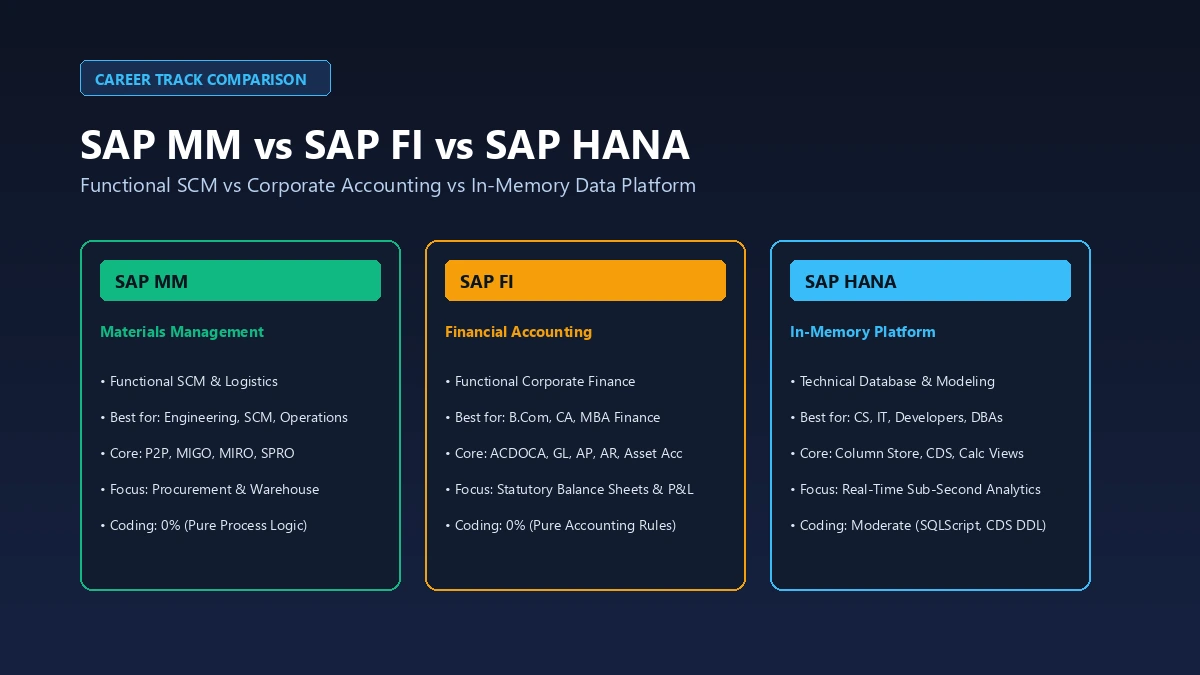
SAP MM vs SAP FI vs SAP HANA: Which Career Path is Right for You in 2026?
Compare SAP MM, SAP FI, and SAP HANA side by side. Discover career prospects, daily responsibilities, salary comparisons, and find the best module for your background.
Read Guide
SAP MM Training in India 2025: Complete Guide to Fees, Duration & Placement
Looking for the best SAP MM training in India? Discover course fees, duration, syllabus breakdown, real-time S/4HANA projects, and how to secure high-paying SAP consultant jobs.
Read Guide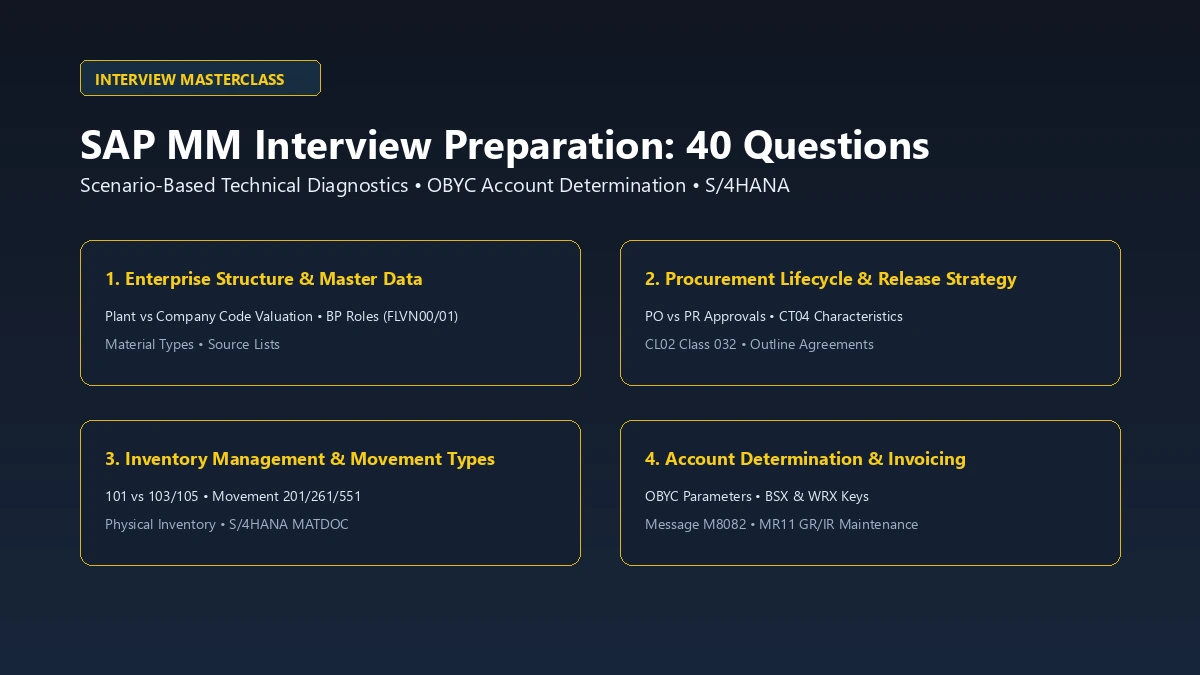
SAP MM Interview Preparation: 40 Practical, Scenario-Based Questions & Answers
Prepare for your SAP MM consultant interview with 40 real-world, scenario-based questions covering P2P, split valuation, physical inventory, PR release strategy, and OBYC integration.
Read Guide