
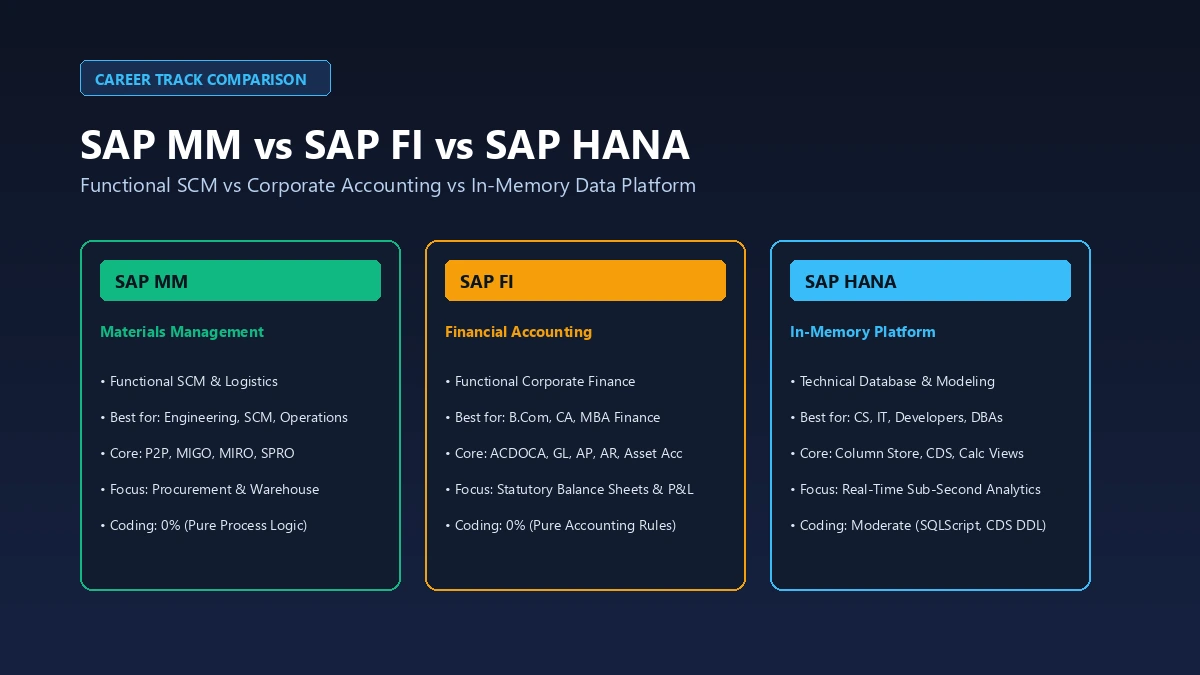
SAP MM vs SAP FI vs SAP HANA: Which SAP Career Path Should You Choose?
When professionals and fresh graduates decide to step into the enterprise resource planning (ERP) domain, they immediately encounter an overwhelming alphabet soup of specialized tracks: SAP MM, SAP FI, SAP HANA, SAP SD, SAP PP, and SAP ABAP.
Choosing the wrong module at the outset is the single most common cause of career friction. We regularly counsel mechanical engineers who struggled through financial balance sheet reconciliations in FICO, or commerce graduates who found themselves overwhelmed trying to configure low-level calculation views and database partitions in SAP HANA.
The truth is that each of these three leading modules—SAP MM (Materials Management), SAP FI (Financial Accounting), and SAP HANA (In-Memory Database & Platform)—represents a fundamentally different pillar of the enterprise ecosystem.
In this definitive comparison guide, we evaluate all three tracks across academic prerequisites, daily consultant responsibilities, functional vs. technical orientation, learning curves, and long-term career progression.
At a Glance: The Three Pillars of Enterprise ERP
To understand which track fits your natural cognitive strengths, look at the primary question each discipline answers:
| Feature / Domain | SAP Materials Management (MM) | SAP Financial Accounting (FI) | SAP HANA (Platform & Analytics) |
|---|---|---|---|
| Core Question | "How does the enterprise source, store, and move physical goods?" | "How does the enterprise record statutory ledgers and report financial health?" | "How does the in-memory engine store, model, and process massive datasets in sub-seconds?" |
| Orientation | Functional (Business Process & Supply Chain) | Functional (Accounting Standards & Financial Governance) | Technical (Database Architecture, Modeling & Analytics) |
| Key Transaction Environment | ME21N, MIGO, MIRO, SPRO Customizing | FB01, FB50, FS00, F.01, Financial Closing | SAP HANA Studio, Eclipse ADT, Database Cockpit, SQL Console |
| Ideal Academic Fit | Mechanical/Civil Engg, Logistics, MBA Supply Chain, General Graduates | B.Com, M.Com, CA, CFA, MBA Finance, Accounting Professionals | Computer Science (B.Tech/BE), BCA/MCA, Software Developers, DBAs |
| Coding Requirement | Zero code (Process configuration & logic) | Zero code (Accounting configuration & logic) | Moderate (SQLScript, CDS DDL syntax, Calc Views) |
Detailed Profile 1: SAP Materials Management (MM)
What You Actually Do Every Day
As an SAP MM functional consultant, you are the architect of corporate supply chain operations. You spend your day interacting with plant directors, procurement managers, warehouse supervisors, and accounts payable teams.
Your job is to translate complex real-world purchasing requirements—such as multi-vendor pricing matrices, automatic reordering thresholds, raw material quality inspections, and subcontracting arrangements—into SAP customizing tables.
Key Skills & Capabilities You Master
- Procurement Lifecycles: Purchase Requisitions (PR), Requests for Quotation (RFQ), Purchase Orders (PO), and Outline Agreements.
- Master Data Governance: Material Master (
MM01), Business Partner / Vendor Master (BP), Purchasing Info Records, and Source Lists. - Inventory & Warehouse Operations: Movement Types (101, 201, 261, 301), Special Stock management (Consignment, Subcontracting), Physical Inventory reconciliation.
- Integration with Finance: Automatic Account Determination (
OBYC) and GR/IR interim liability management.
Who Thrives Best in SAP MM?
- Graduates from Mechanical, Civil, Production, or Industrial Engineering who understand how physical parts move through manufacturing facilities.
- Professionals with practical background in storekeeping, warehouse operations, procurement, import/export, or retail logistics.
- Anyone who prefers visual, process-driven workflows over complex mathematical balancing or software code.
Detailed Profile 2: SAP Financial Accounting (FI)
What You Actually Do Every Day
SAP FI is the regulatory and compliance backbone of the corporation. As an SAP FI consultant, you collaborate directly with Chief Financial Officers (CFOs), corporate controllers, tax directors, and statutory auditors.
Your objective is ensuring that every commercial event across the company—whether issuing a customer invoice, calculating asset depreciation, or closing monthly financial books—records accurate debit and credit ledger postings conforming to IFRS, US GAAP, or local statutory standards.
Key Skills & Capabilities You Master
- General Ledger (G/L) Accounting: Universal Journal (
ACDOCAin S/4HANA), Chart of Accounts, Document Splitting, and Fiscal Year Variants. - Sub-Ledgers: Accounts Payable (AP - vendor liabilities), Accounts Receivable (AR - customer revenues and collections), and Bank Accounting (
F110automated payment runs). - Asset Accounting (FI-AA): Asset capitalization, Asset Under Construction (AuC) settlement, and automated periodic depreciation (
AFAB). - Financial Period Closing: Revaluations (
FAGL_FCV), accruals (FBS1), and balance sheet / P&L statement generation (F.01).
Who Thrives Best in SAP FI?
- Candidates with formal academic backgrounds in Commerce (B.Com, M.Com), Chartered Accountancy (CA, Inter-CA), CPA, CMA, or MBA in Finance.
- Working accountants, bank analysts, audit associates, and tax specialists looking to multiply their commercial value through enterprise software expertise.
- Individuals with high attention to detail who enjoy financial precision, audit governance, and balance sheet integrity.
Detailed Profile 3: SAP HANA (In-Memory Database & Analytics)
What You Actually Do Every Day
Unlike MM and FI, which are functional business modules, SAP HANA is a technical data and analytics discipline. As an SAP HANA specialist or data architect, your workspace is Eclipse, SAP HANA Studio, and database administration cockpits.
You do not spend your day debating invoice tolerances with accountants. Instead, you design lightning-fast database structures, build Core Data Services (CDS Views), write complex SQLScripts, build Calculation Views, optimize memory consumption, and orchestrate real-time data replication from legacy databases into in-memory storage.
Key Skills & Capabilities You Master
- In-Memory Architecture: Columnar data storage, dictionary compression, parallel processing, and memory partition management.
- HANA Modeling: Graphic and Script-based Calculation Views, multidimensional analytical cubes, and aggregated projection layers.
- Code Pushdown & CDS: Moving business logic from the application server down into the database layer via Core Data Services (CDS) and AMDP (ABAP Managed Database Procedures).
- Data Provisioning: Real-time data migration via SAP Landscape Transformation (SLT), Smart Data Integration (SDI), and SAP Cloud Integration.
Who Thrives Best in SAP HANA?
- Candidates with degrees in Computer Science (B.Tech, B.E., BCA, MCA, B.Sc IT) or self-taught programmers.
- Professionals with prior experience in Relational Databases (SQL Server, Oracle, MySQL, PostgreSQL), ETL pipelines, Business Intelligence (BI/Power BI), or Data Warehousing.
- Analytical minds who love database modeling, algorithmic performance tuning, and technical problem-solving.
The 4-Question Decision Diagnostic: Which Track Fits You?
If you are still weighing your options, ask yourself these four diagnostic questions:
1. What was your academic foundation?
- Commerce, Accounting, Taxation, or Corporate Finance: Choose SAP FI. Your accounting literacy is your biggest superpower; do not discard it.
- Engineering (Non-CS), Logistics, Supply Chain, Operations, or General Studies: Choose SAP MM. You will understand supply chain operations rapidly without getting bogged down in debits and credits.
- Computer Science, IT, Programming, or Database Administration: Choose SAP HANA. You can leverage your technical baseline to master modern in-memory data modeling.
2. How do you feel about writing database queries and technical code?
- "I enjoy programming, writing SQL, and understanding database mechanics." $\rightarrow$ SAP HANA.
- "I prefer understanding business processes, configuring system rules, and guiding clients without writing code." $\rightarrow$ SAP MM or SAP FI.
3. What kind of daily work environment energizes you?
- Facilitating client workshops with procurement directors to streamline warehouse operations: SAP MM.
- Structuring corporate audit frameworks and closing financial periods with senior controllers: SAP FI.
- Tuning sub-second query performance across tables holding 100 million records: SAP HANA.
4. How steep is the learning curve for a beginner?
- SAP MM: Moderately gentle. Business processes are highly visual and intuitive. Most learners reach initial competence within 8 to 10 weeks of dedicated sandbox configuration.
- SAP FI: Moderate to steep if you lack accounting knowledge; gentle if you already understand debits, credits, and balance sheets.
- SAP HANA: Moderate to steep, requiring a grasp of relational database fundamentals, SQL, and data modeling logic.
Frequently Asked Questions (FAQ)
Can I learn SAP MM and SAP FI together?
While both modules integrate closely through automatic account determination (OBYC), we strongly recommend mastering one module first. Attempting to learn procurement customizing and financial document splitting simultaneously creates cognitive overload. Master either MM or FI thoroughly, then study cross-module integration points.
Which module has more job openings in India and globally?
Both SAP MM and SAP FI have consistently ranked among the top two functional modules in terms of enterprise job volume for over two decades. Every organization running SAP must have both materials management and financial accounting configured. SAP HANA skills are in high demand across migration projects as companies transition legacy ECC databases to S/4HANA.
Can an engineering graduate learn SAP FI?
While possible, engineers who take SAP FI must spend considerable extra time learning basic accounting principles (journal entries, balance sheets, depreciation, accruals). An engineering graduate generally finds SAP MM far more natural and faster to master.
Conclusion & Next Steps in Your Enterprise Career
There is no single "best" SAP module; there is only the module that best aligns with your background, analytical style, and career ambitions. Choosing a module that complements your natural strengths ensures that your training translates directly into interview confidence and high-performing client consulting.
Explore our comprehensive curriculum and speak with our lead mentor:
- SAP MM (Materials Management) Training Course
- SAP FI (Financial Accounting) Training Course
- SAP HANA In-Memory Modeling & Analytics Track
- SAP Consultant Career Transition Guide for Non-IT Learners
- SAP Training vs MBA in India: Return on Investment Analysis
Ready to Accelerate Your Career with Career?
Stop struggling with fragmented tutorials. Get trained personally by Akshay Kumar (6+ years experience, 500+ placed professionals) with real-time S/4HANA server access, business blueprint scenarios, and 100% interview preparation.

Related Tutorials & Articles
Continue learning with more insights from ERP Academy experts.
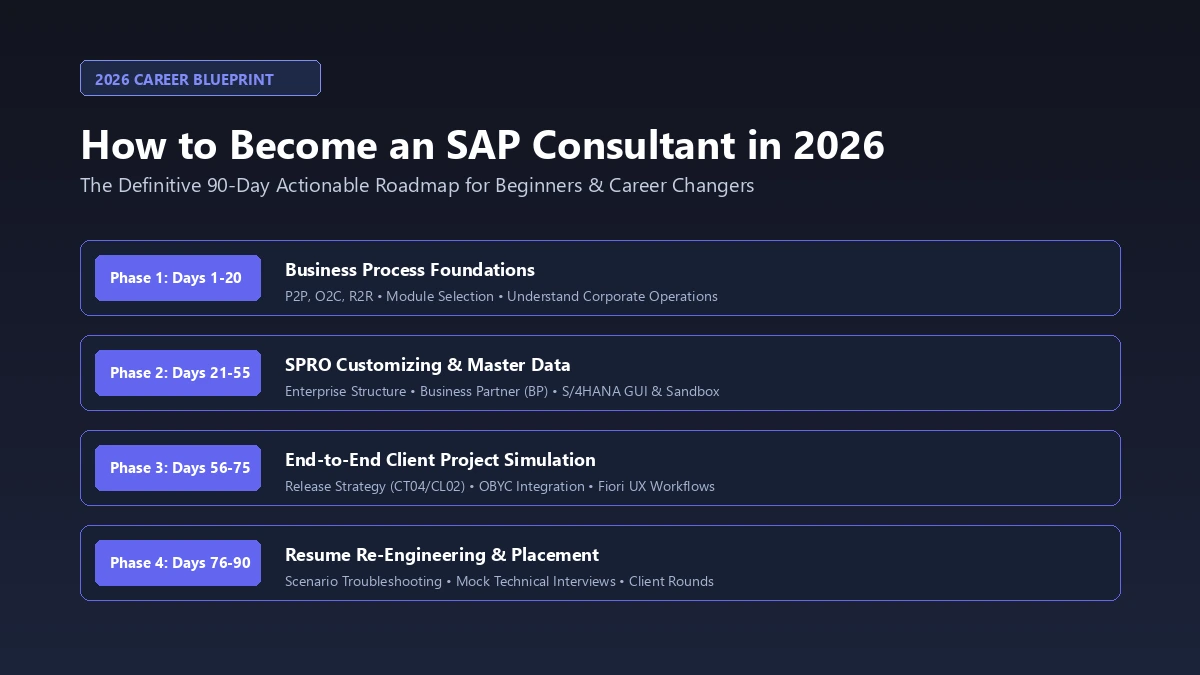
How to Become an SAP Consultant in 2026: The Step-by-Step Practical Roadmap
A realistic, zero-fluff 90-day roadmap to breaking into SAP consulting without prior enterprise experience. Learn the right modules, portfolio projects, and interview strategies.
Read Guide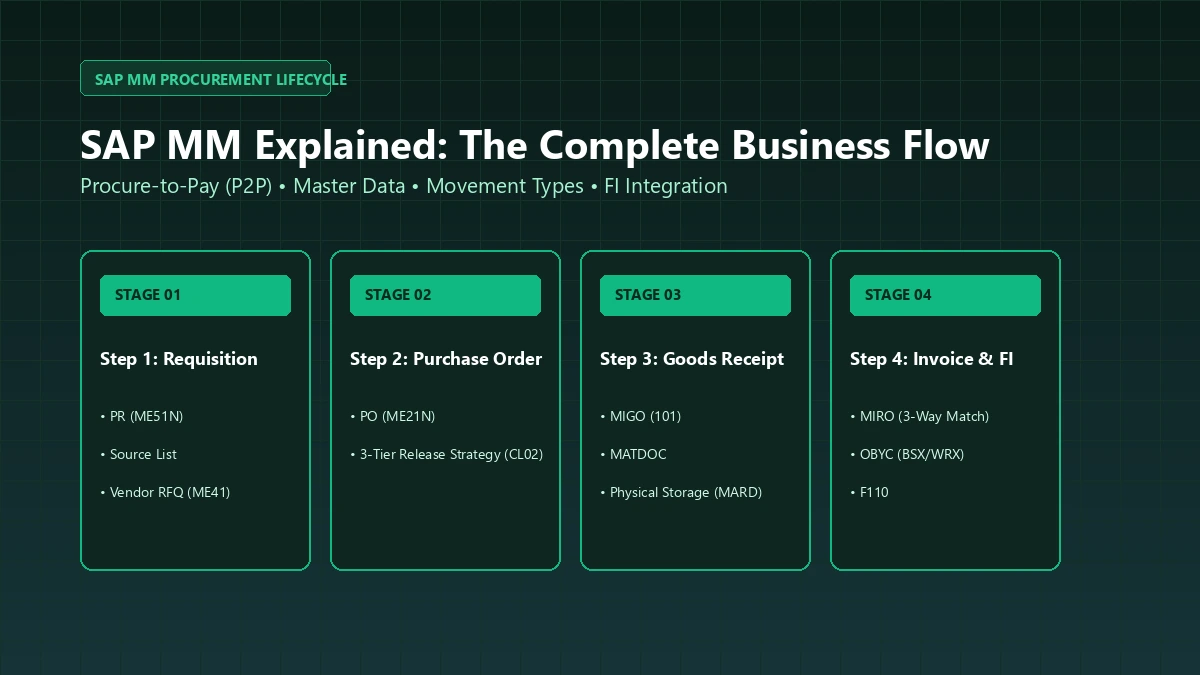
SAP MM Explained: The Complete Procurement & Inventory Business Process (P2P Cycle)
Master SAP MM from business processes to system configuration. Complete guide to Procure-to-Pay (P2P), master data, movement types, and automatic account determination (OBYC).
Read Guide
How to Get a Job After SAP Training in India: Step-by-Step Guide (2025)
Learn proven strategies to land your first SAP consultant job in India. Discover resume templates, interview preparation tips, and placement secrets.
Read Guide