
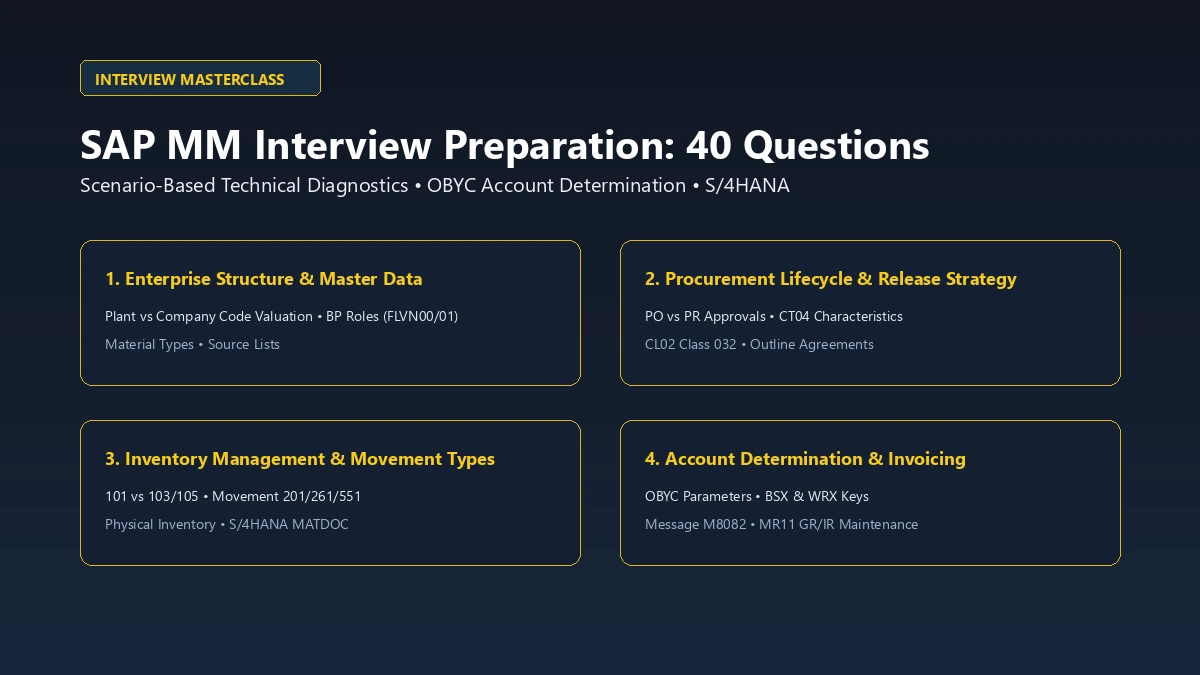
SAP MM Interview Preparation: 40 Practical Questions, Scenarios, and Answers
Securing an SAP Materials Management (MM) consulting offer at top-tier consulting firms (such as Accenture, Deloitte, PwC, EY, TCS, Infosys, and Capgemini) requires far more than reciting textbook definitions.
In modern 2026 technical interviews, senior solution architects deliberately steer away from simple questions like "What is a Purchase Order?" Instead, they test your diagnostic instincts through real-world project scenarios, customizing dependencies, and system error troubleshooting:
- "Why did a PO fail to trigger an approval strategy after the net value changed?"
- "How does the system determine the GL account during a 101 Goods Receipt?"
- "What happens if a vendor invoice price exceeds the PO price by 15%?"
In this comprehensive guide, we have assembled 40 essential, scenario-based SAP MM interview questions categorized across the five core operational domains. Each answer includes both the conceptual rationale and the exact system customizing dependencies.
Domain 1: Enterprise Structure & Master Data (Questions 1–8)
Question 1: What is the architectural difference between a Plant-Specific Purchasing Organization and a Cross-Plant Purchasing Organization?
- Answer: A Plant-Specific Purchasing Organization is assigned to one specific plant within a company code in
SPROand negotiates contracts exclusively for that single location. A Cross-Plant Purchasing Organization is assigned to a company code and procures materials across multiple plants within that same company code. If an organization is not assigned to any company code, it becomes a Cross-Company Code Purchasing Organization, enabling centralized corporate procurement across multiple distinct legal entities.
Question 2: Why is the Valuation Area almost universally configured at the Plant level rather than Company Code level?
- Answer: Under SAP standard architecture, if the valuation area is set at the company code level, a material must share the exact same valuation price across all plants within that company code. In reality, transportation tariffs, local taxes, and procurement overhead differ between plants (e.g. Pune vs. Chennai). Setting the valuation area at the Plant level allows independent material pricing, standard costing, and automatic account determination for each physical site. Furthermore, Material Requirements Planning (MRP) and Production Planning (PP) require plant-level valuation.
Question 3: How does S/4HANA handle vendor master records compared to legacy ECC?
- Answer: In legacy ECC, vendor masters were created via transaction
XK01orFK01and stored in tableLFA1. In modern SAP S/4HANA, all customer and vendor maintenance is consolidated under the unified Business Partner (BP) transaction code. The vendor roleFLVN00creates company code financial views, whileFLVN01creates purchasing organization views. Customer-Vendor Integration (CVI) synchronizes BP master data with underlying compatibility views in real time.
Question 4: What is the purpose of the Material Type (MTART) in SAP MM?
- Answer: The Material Type governs critical system behaviors:
- It controls whether the material is subject to quantity updating and/or value updating in the valuation area.
- It defines the number range (internal vs. external).
- It determines which field screens appear during
MM01(e.g., raw materialROHhas purchasing views, whereas non-stockNLAGlacks inventory storage views). - It determines the default Valuation Class range available for accounting determination.
Question 5: What is a Source List and when is it mandatory?
- Answer: A Source List (
ME01) defines approved or blocked suppliers for a specific material and plant over a designated validity period. It is mandatory when the "Source List Requirement" flag is checked in the Material Master (Purchasing view) or at the Plant level inSPRO. When enforced, users cannot issue a Purchase Order without selecting an active vendor from the source list.
Question 6: What is a Purchasing Info Record (PIR) and what data does it store?
- Answer: A Purchasing Info Record (
ME11) establishes the commercial relationship between a specific material and an individual vendor at the Purchasing Organization and Plant level. It stores agreed pricing conditions, vendor lead time, minimum order quantities, tax codes, tolerance limits for over/under-deliveries, and the most recent PO document number.
Question 7: What are the four types of Purchasing Info Records?
- Answer: The four PIR categories are:
- Standard: Normal inventory procurement.
- Subcontracting: Sourcing finished goods where raw components are supplied to the vendor.
- Consignment: Vendor-owned stock stored on client premises.
- Pipeline: Materials flowing continuously through pipelines or cables (e.g., electricity, fuel, water).
Question 8: How do you handle Material Master changes without impacting past transactions?
- Answer: Material Master modifications (e.g., changing purchasing group or order unit) take effect dynamically only for future transactions. Historical documents (existing Purchase Orders and Goods Receipts) retain the master data snapshot captured at their specific creation timestamps.
Domain 2: Procurement Lifecycle & Purchasing Documents (Questions 9–16)
Question 9: Can a Purchase Order be released at the line-item level?
- Answer: No. Purchase Orders can only be released at the document header level using classification (Communication Structure
CEKKO). Because a PO is a legally binding commercial contract with an external supplier, an enterprise cannot issue a partially approved document. Conversely, Purchase Requisitions (PRs) support both item-level and header-level release procedures.
Question 10: An end user reports that the "Release Strategy" tab is missing from a Purchase Order in ME21N. What are the root causes?
- Answer: This is a classic helpdesk issue. The consultant should verify:
- Communication Structure Alignment: Verify that fields in characteristics (
CT04) matchCEKKOexactly (e.g., usingCEKKO-GNETWrather thanEKKO-NETWR). - Value Outside Range: The PO total net value or purchasing group falls outside the maintained characteristic intervals in the classification matrix (
CL20N/CL24N). - Currency Conversion: If PO currency differs from characteristic currency, verify that exchange rates are maintained in table
TCURR. - Blank Classification Values: Missing classification values for document type, plant, or purchasing organization.
- Communication Structure Alignment: Verify that fields in characteristics (
Question 11: What is the difference between a Contract and a Scheduling Agreement?
- Answer:
- A Contract (
ME31K) is an outline agreement outlining fixed quantities (Quantity Contract) or total monetary value (Value Contract) over a validity period. Deliveries are executed by creating formal Release Orders (Purchase Orders) referencing the contract. - A Scheduling Agreement (
ME31L) is an outline agreement where line items are delivered on specific calendar schedule lines (ME38) directly without requiring individual purchase orders, ideal for just-in-time (JIT) manufacturing.
- A Contract (
Question 12: What is the purpose of the Document Type in purchasing documents?
- Answer: The Document Type (e.g., standard PO type
NB, stock transport orderUB) controls:- The allowed number range interval (internal or external).
- Field selection screen references (mandatory, optional, or hidden fields).
- Allowed item categories (e.g., Subcontracting
L, ConsignmentK, Third-PartyS). - Linkage to Release Strategies.
Question 13: How does the system determine whether an item category requires a Goods Receipt?
- Answer: In
SPROcustomizing for Purchasing Document Item Categories, each item category specifies default indicators for Goods Receipt (WE) and Invoice Receipt (RE). For instance, Item CategoryT(Text) or service items without physical stock can disable goods receipts.
Question 14: What is the significance of the "Version Management" tab in a Purchase Order?
- Answer: Version Management tracks change history for auditing. If a buyer alters net prices, quantities, or delivery dates on an approved PO, the system locks the document, creates a new version number (e.g., Version 1 $\rightarrow$ Version 2), and forces the PO back through managerial re-approval.
Question 15: How do you configure automatic PO generation from an approved Purchase Requisition?
- Answer: Three conditions must be satisfied:
- The "Automatic PO" flag is checked in the Material Master Purchasing view.
- The "Automatic PO" flag is checked in the Vendor Master / Business Partner purchasing view.
- A valid Purchasing Info Record with pricing and an active Source List entry exist. The PR is then converted via transaction
ME59N.
Question 16: What is a Stock Transport Order (STO)?
- Answer: An STO procures materials from one internal plant to another. Unlike a simple inventory transfer (
301), an STO involves a formal Purchase Order (UBdocument type) and delivery via Sales & Distribution (SD shipping and billing), enabling freight tracking, transport documentation, and transit stock visibility (MARC-TRAME).
Domain 3: Inventory Management & Movement Types (Questions 17–24)
Question 17: What is the difference between Movement Type 101 and Movement Type 103?
- Answer:
- Movement Type
101: Posts an immediate Goods Receipt into unrestricted usable warehouse stock. It updates stock quantity and generates an automated financial accounting entry (Debit Inventory, Credit GR/IR). - Movement Type
103: Posts goods into GR-Blocked Stock. It updates physical quantities for tracking at the warehouse gate but does not update company valuation or post an accounting journal. Goods are only capitalized when released into unrestricted stock via Movement Type105.
- Movement Type
Question 18: What is the difference between Movement Type 101 and Movement Type 107?
- Answer: Movement Type
107posts goods into Origin Accepted Stock at the supplier's warehouse prior to transportation. Company inventory increases in value (accounting document generated), but physical stock remains off-site until released upon physical arrival via Movement Type109.
Question 19: Explain Movement Types 201 vs. 261.
- Answer:
- Movement Type
201: Issues goods from warehouse stock directly to an internal Cost Center (Operating Expense consumption). - Movement Type
261: Issues raw materials from warehouse stock to a Production Order (Work in Process inventory asset in manufacturing).
- Movement Type
Question 20: What happens behind the scenes during Movement Type 551?
- Answer: Movement Type
551scraps damaged, expired, or obsolete stock:- Inventory quantity in
MARDis reduced to zero for the scrapped units. - Accounting Entry: Debit Scrap Expense Account (
PRD/ Scrapping Loss), Credit Inventory Asset Account (BSX).
- Inventory quantity in
Question 21: How do you resolve a physical inventory discrepancy in SAP?
- Answer: Using the 3-step physical inventory workflow:
- Create Physical Inventory Document via
MI01. - Enter physical count results via
MI04. - Post inventory differences via
MI07. Posting difference automatically posts financial accounting adjustments to inventory loss/gain accounts.
- Create Physical Inventory Document via
Question 22: What is Split Valuation and when is it required?
- Answer: Split Valuation allows an enterprise to value the same material at different prices within the same plant. Common use cases include:
- Sourcing the same part both internally (manufactured) and externally (purchased).
- Segregating new versus refurbished/used spare parts.
- Tracking different batch quality grades (Batch Valuation).
Question 23: What are the three stock statuses in SAP inventory?
- Answer:
- Unrestricted-Use Stock: Usable immediately for production, sales, or transfer.
- Quality Inspection Stock (
INSME): Under lab testing; cannot be issued to production. - Blocked Stock (
SPEME): Defective or unapproved inventory; restricted from consumption.
Question 24: What is the Universal Material Document in S/4HANA?
- Answer: In S/4HANA, the historical tables
MKPF(Material document header) andMSEG(Material document line items) are consolidated into a single unified table:MATDOC. This architectural change enables real-time inventory reporting without database locks.
Domain 4: Special Procurement Scenarios (Questions 25–32)
Question 25: How does Subcontracting work in SAP MM?
- Answer: The client sends raw material components to an external vendor who performs assembly and returns the finished good.
- Components are transferred to the vendor via
MIGOwith Movement Type541(Stock provided to vendor - non-valuated transfer). - When the finished product arrives, receipt is posted via
MIGO(Item CategoryL): Movement Type101receives the finished product, while automated Movement Type543consumes the raw materials from vendor stock.
- Components are transferred to the vendor via
Question 26: What is Vendor Consignment?
- Answer: The vendor places inventory in the client's warehouse, but ownership remains with the vendor until the client physically consumes the stock.
- Goods receipt is posted via
MIGO(Item CategoryK) with Movement Type101(Valueless to client). - When consumed, Movement Type
411 Ktransfers consignment stock to own unrestricted stock. - Invoicing does not use
MIRO; the liability is settled periodically using transactionMRKO.
- Goods receipt is posted via
Question 27: What is Third-Party Order Processing?
- Answer: A customer orders products from your company, but you instruct an external supplier to ship the goods directly to the customer.
- A Sales Order generates an automated Purchase Requisition with Item Category
S. - A PO is issued to the supplier.
- The supplier ships directly to the end customer. A statistical goods receipt or direct
MIROinvoice triggers customer billing in SD (VF01).
- A Sales Order generates an automated Purchase Requisition with Item Category
Question 28: What is Pipeline Handling?
- Answer: Used for continuous utility commodities (water, gas, electricity) consumed directly from a supplier pipeline without warehouse storage. Stock receipts are not booked; liabilities are settled directly in
MRKObased on meter readings.
Question 29: What is Return Delivery to Vendor and which Movement Type is used?
- Answer: When delivered materials are rejected during inspection, goods are returned to the supplier using Movement Type
122(Return to vendor referencing the original PO) or Movement Type161(Return Purchase Order).
Question 30: What is a Blanket Purchase Order?
- Answer: Used for procurement of low-value consumable items (e.g. stationery, office supplies) with Item Category
Band Document TypeFO(Framework Order). It sets an overall monetary limit and validity period, eliminating the need for individual goods receipts.
Question 31: How does Service Procurement differ from Material Procurement?
- Answer: Service procurement uses Item Category
D. Instead of a material master, it references a Service Master (AC03). Rather than posting physical goods receipts inMIGO, the completion of service work is documented and accepted via a Service Entry Sheet (SES) using transactionML81N.
Question 32: What is the difference between a Standard Price (S) and a Moving Average Price (V)?
- Answer:
- Standard Price (
S): The inventory is always valued at a fixed, predefined price. Any variance between the Purchase Order price and standard price is routed to a Price Difference Account (PRD). - Moving Average Price (
V): The material unit value adjusts dynamically with every goods receipt:New Price = (Total Existing Value + New GR Value) / (Total Existing Quantity + New GR Quantity).
- Standard Price (
Domain 5: Account Determination & Invoice Verification (Questions 33–40)
Question 33: How does Automatic Account Determination (OBYC) work in SAP MM?
- Answer: When an inventory movement or invoice is posted, SAP automatically derives the correct General Ledger account without manual user entry using five parameters:
- Chart of Accounts (assigned to Company Code).
- Valuation Grouping Code (links multiple valuation areas via
OMWD). - Transaction Key (e.g.,
BSX,WRX,PRD). - Account Modifier (refines specific offsetting entries in
GBB, e.g.,VBRfor internal consumption). - Valuation Class (from Material Master Accounting view).
Question 34: What is the purpose of Transaction Key BSX in OBYC?
- Answer:
BSXdefines the Balance Sheet Inventory Asset Account. Whenever inventory quantities or values increase (Goods Receipt101) or decrease (Goods Issue201), the system posts directly to the G/L account mapped toBSX.
Question 35: What is the purpose of Transaction Key WRX?
- Answer:
WRXdefines the GR/IR (Goods Receipt / Invoice Receipt) Clearing Account. It serves as an interim balance sheet liability account that balances timing discrepancies between the physical arrival of goods and the arrival of the vendor bill.
Question 36: What causes Error "Message M8082: Price variance exceeded"?
- Answer: During invoice verification (
MIRO), the invoiced price per unit exceeds the Purchase Order net price by a percentage greater than the tolerance limits configured inSPROunder Invoice Verification Tolerance Keys (e.g., Tolerance KeyPP). The invoice can be parked but is automatically blocked for payment.
Question 37: How do you clear lingering balances in the GR/IR account when a vendor fails to deliver remaining items?
- Answer: Execute transaction
MR11(GR/IR Account Maintenance).MR11clears residual quantity differences between goods receipts and invoices, posting offsetting balancing entries to price difference (PRD) or inventory asset accounts.
Question 38: What is the difference between Park, Hold, and Save in MIRO?
- Answer:
- Hold: Saves incomplete data locally without generating an accounting document or performing validation.
- Park: Validates syntax and generates an unposted accounting document; does not update G/L balances.
- Post / Save: Verifies the three-way match, updates General Ledger balances, and creates an open payable item for the supplier.
Question 39: What is ERS (Evaluated Receipt Settlement)?
- Answer: ERS (
MRRL) automates supplier payments for high-trust vendors without requiring a paper invoice. Based on the Goods Receipt and PO pricing conditions, SAP automatically calculates the payable amount and posts the invoice voucher directly.
Question 40: What is the Valuation Class and how does it connect the Material Master to the General Ledger?
- Answer: The Valuation Class is an assignment in the Material Master Accounting View (
MM01) that acts as the bridge to financial accounting. InOBYC, General Ledger accounts are assigned to specific Valuation Classes. This ensures that different categories of materials (e.g., Raw Fasteners class3000vs. Finished Packaging class7920) automatically post to their respective general ledger balance sheet accounts without manual intervention.
Frequently Asked Questions (FAQ)
How should I prepare for scenario-based SAP MM interview questions?
The most effective way is hands-on simulation in a sandbox environment. When asked how an STO works, do not merely state the definition; explain the step-by-step customizing in SPRO: defining shipping data for plants, assigning customer numbers to receiving plants, configuring document type UB, and tracking document flow between MIGO and VF01.
What is the most critical integration topic asked in SAP MM interviews?
Without question, MM-FI Integration (OBYC). Over 40% of technical interview questions focus on how goods movements trigger automated accounting entries, how the GR/IR clearing account works, and how to resolve posting errors like missing account assignments (Message KI235).
Conclusion & Advancing Your Interview Preparation
Mastering these 40 questions gives you the technical vocabulary, configuration depth, and diagnostic instincts required to excel in senior consulting interviews.
To practice these configuration matrices and error scenarios on live enterprise S/4HANA systems, explore our specialized programs:
- SAP MM Comprehensive Training Course & Sandbox Practice
- SAP MM-FI Integration & OBYC Configuration Guide
- SAP MM Release Strategy Configuration: PO & PR Guide
- How to Become an SAP Consultant in 2026: Beginner Roadmap
Ready to Accelerate Your Career with SAP MM?
Stop struggling with fragmented tutorials. Get trained personally by Akshay Kumar (6+ years experience, 500+ placed professionals) with real-time S/4HANA server access, business blueprint scenarios, and 100% interview preparation.

Related Tutorials & Articles
Continue learning with more insights from ERP Academy experts.
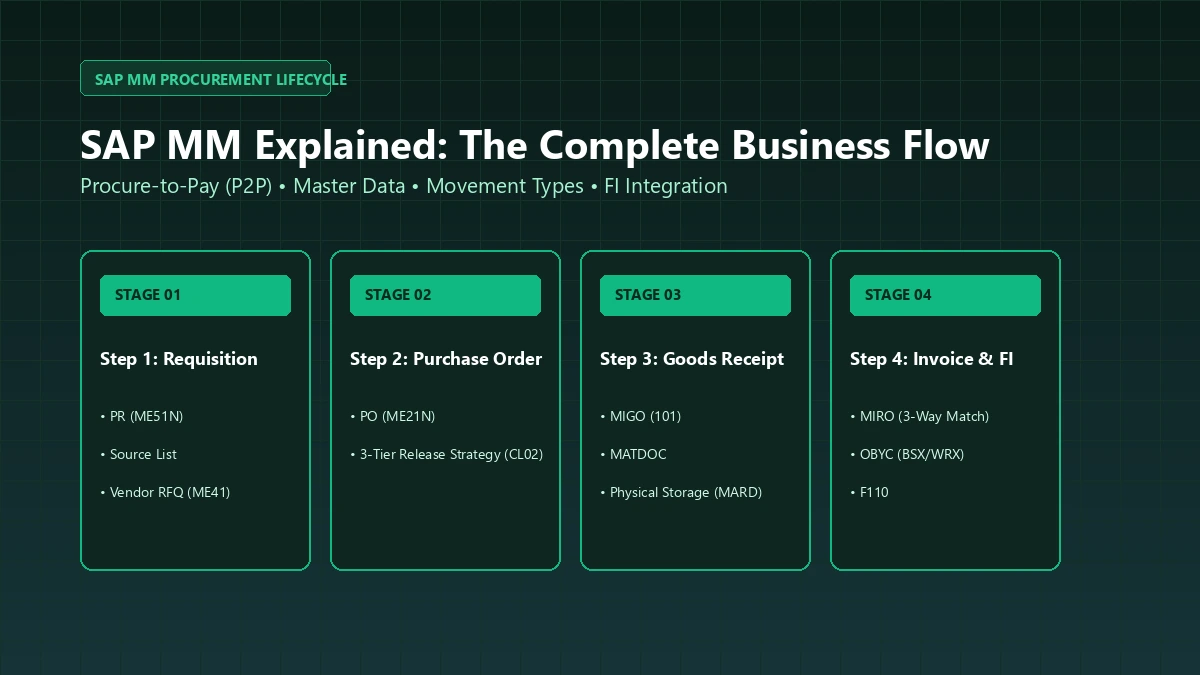
SAP MM Explained: The Complete Procurement & Inventory Business Process (P2P Cycle)
Master SAP MM from business processes to system configuration. Complete guide to Procure-to-Pay (P2P), master data, movement types, and automatic account determination (OBYC).
Read Guide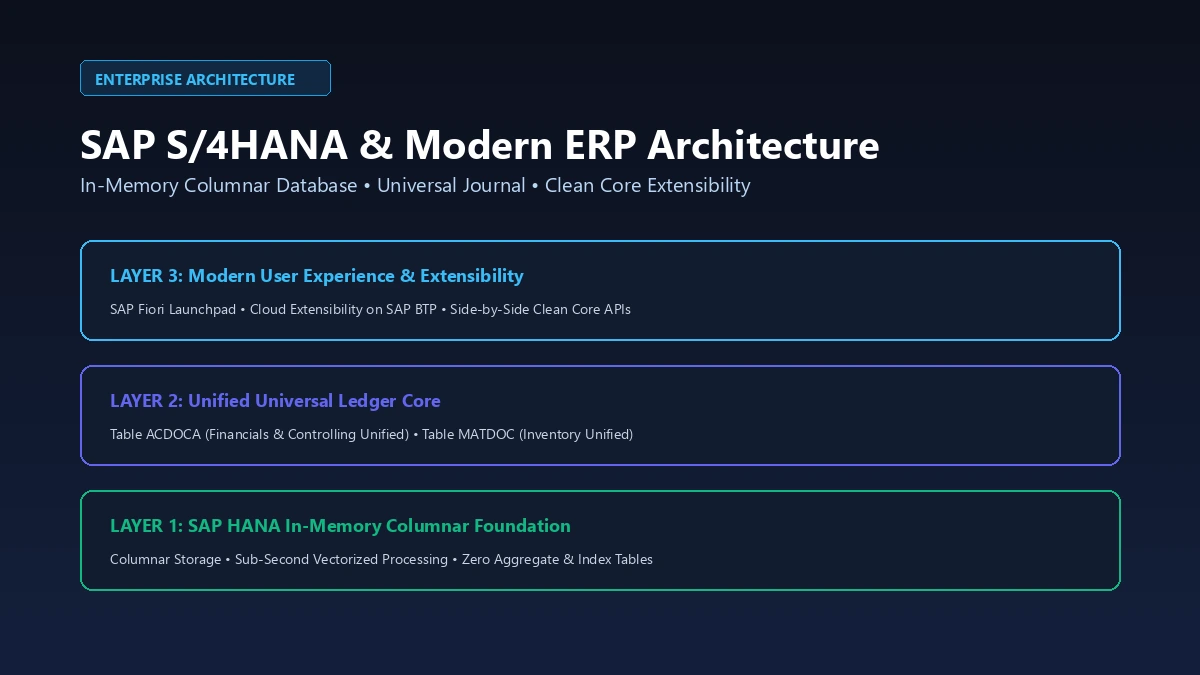
What is SAP S/4HANA? Modern ERP Architecture & Essential Skills for 2026
Understand how SAP S/4HANA revolutionized enterprise architecture. Explore in-memory computing, universal journal ACDOCA, Fiori UX, and the critical skills consultants need today.
Read Guide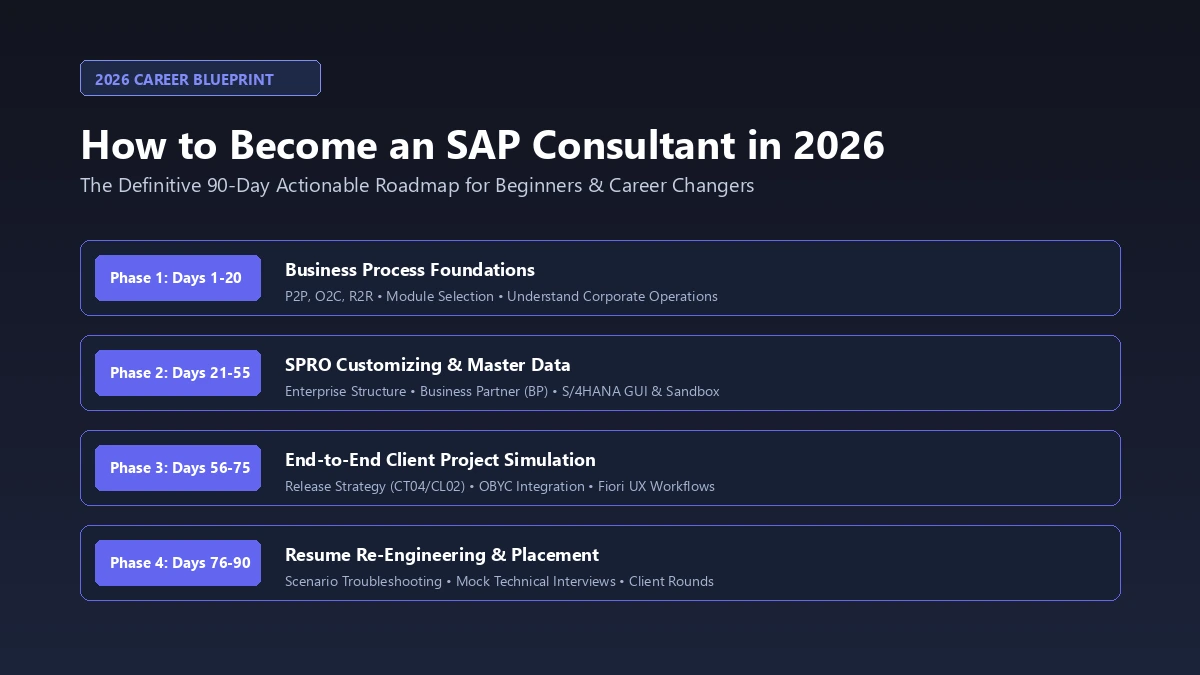
How to Become an SAP Consultant in 2026: The Step-by-Step Practical Roadmap
A realistic, zero-fluff 90-day roadmap to breaking into SAP consulting without prior enterprise experience. Learn the right modules, portfolio projects, and interview strategies.
Read Guide