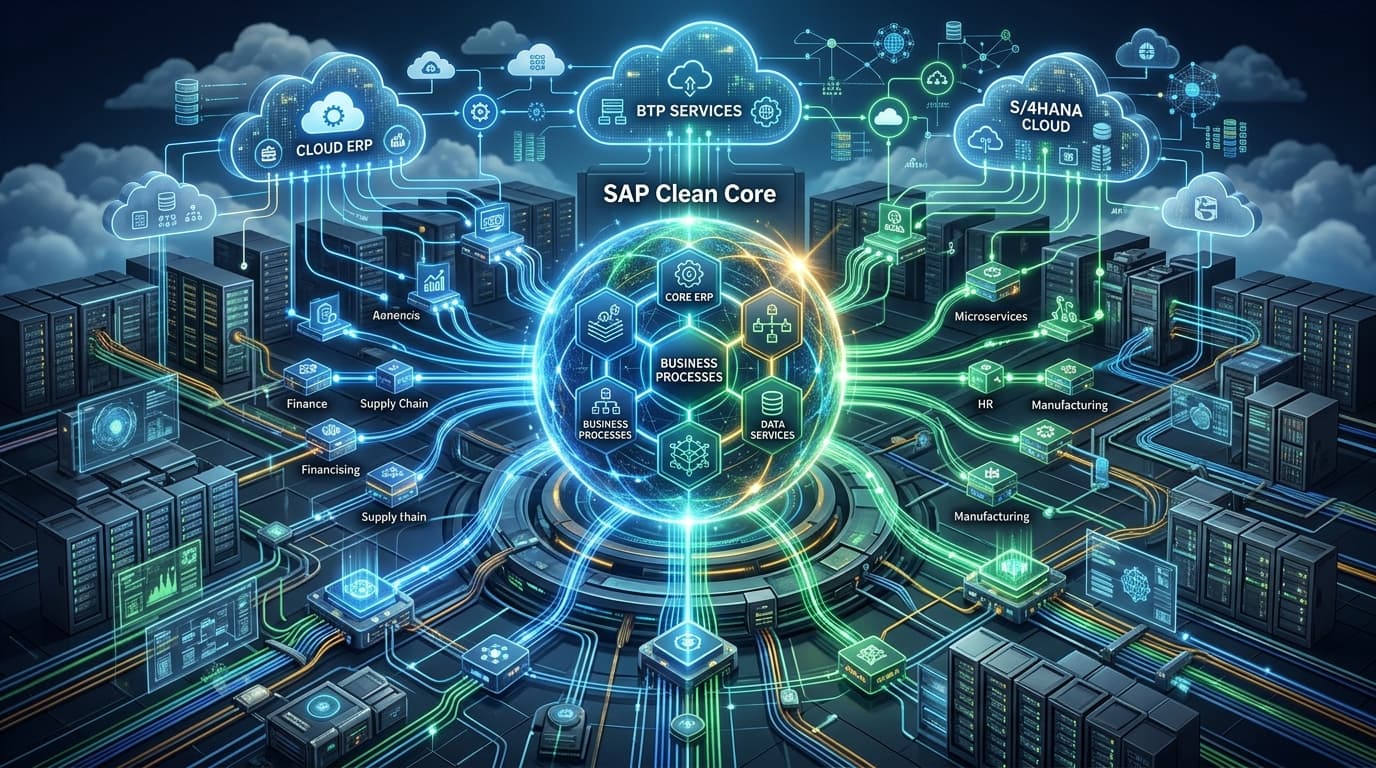
Why SAP Clean Core Is Making or Breaking S/4HANA Migrations (And What Developers Need to Know)
A few years ago, I was brought in as an external consultant for a legacy ECC 6.0 upgrade at a massive manufacturing enterprise in Pune.
The client's IT director looked exhausted. He slid a printout across the conference table and said:
"Akshay, our system has over 4,200 custom Z-programs, 650 user exits, 180 custom database tables, and three direct modifications to standard SAP source code in
MV45AFZZ. We've been trying to upgrade to S/4HANA for 14 months, our budget has ballooned by ₹12 Crores, and every time we apply a support package, half our billing cycle breaks."
Sound familiar?
If you have worked with SAP systems for more than five minutes, you know this story all too well. For decades, the standard response of any enterprise ABAP team to a business requirement was: "Just create a Z-table, write a custom report in SE38, or slap a user-exit into the standard sales order program."
It solved the immediate requirement for the business, but it created an architectural monstrosity known as technical debt.
Today, SAP has drawn a firm line in the sand with SAP Clean Core. If you are preparing for S/4HANA Cloud, RISE with SAP, or modern enterprise consulting, Clean Core is not just a nice-to-have philosophy—it is the governing standard for how modern software gets built.
Let's strip away the corporate marketing jargon and look at what Clean Core actually means for architects, developers, and functional consultants on the ground.
1. What Does "Clean Core" Actually Mean? (No Marketing Fluff)
At its heart, Clean Core means one fundamental principle:
The standard enterprise core ERP system must remain completely untouched, strictly decoupled, and always ready for automated software updates without breaking custom business logic.
In traditional SAP ECC systems, custom code lived directly inside the standard application layer. You could run SE38, insert custom code into standard function modules, perform direct SELECT queries on internal database tables, and bypass standard business logic.
When SAP released a support package or upgrade, those internal tables or function signatures changed. The result? Total system chaos, months of regression testing, and millions spent on code remediation.
Under a Clean Core strategy:
- Zero Modifications: You never touch standard SAP code. Period.
- Strict Public APIs Only: Custom code can only interact with standard SAP objects through Officially Released APIs (Contract C1).
- Decoupled Extensions: New applications, custom user interfaces, and complex integrations live outside the core ERP—primarily on SAP Business Technology Platform (BTP).
+-------------------------------------------------------------+
|                Side-by-Side Extensions (SAP BTP)            |
|       - SAP Build Apps / UI5 Fiori Custom Applications      |
|       - Node.js / Java Cloud Application Programming (CAP)  |
|       - Event-Driven Architecture (SAP Event Mesh)          |
+------------------------------▲------------------------------+
                               │ Public APIs (OData / REST)
+------------------------------▼------------------------------+
|             SAP S/4HANA Cloud Core (Clean Core)             |
|  - Standard Business Processes (Order-to-Cash, Procure-to-Pay)|
|  - On-Stack ABAP Cloud Extensions (RAP / Developer Tier 1)  |
|  - Released Core Data Services (CDS) Views                  |
|  - Strictly Decoupled from Legacy Z-Programs               |
+-------------------------------------------------------------+
2. The 5 Pillars of a Truly Clean Core
SAP's Clean Core methodology is not just about writing clean ABAP code; it spans five interdependent architectural pillars:
| Pillar | What It Means in Practice | Real-World Enterprise Example |
|---|---|---|
| 1. Extensibility | Use ABAP Cloud and SAP BTP instead of legacy user exits or direct table updates | Build custom approval workflows on BTP rather than customizing ME51N screens |
| 2. Business Processes | Adopt standard SAP Best Practice processes out of the box ("Fit-to-Standard") | Avoid rewriting standard billing cycles to match a 20-year-old spreadsheet habit |
| 3. Data Management | Maintain strict data governance, clean master data, and archival policies | Archive obsolete 10-year-old transactional data before migrating to expensive HANA RAM |
| 4. Integrations | Use well-governed, standard APIs via SAP Business Accelerator Hub | Replace direct database RFC queries with governed OData v4 or REST services |
| 5. Operations | Automated testing, continuous delivery, and regular automated cloud upgrades | Run automated test suites via SAP Cloud ALM to validate zero regression |
3. The 3-Tier Extensibility Model: ABAP Cloud vs. Classic ABAP
The single biggest shift for developers is the introduction of ABAP Cloud. If you are an ABAP programmer whose daily workflow revolves around SE38, SE11, and classic CALL FUNCTION, you need to pay close attention.
SAP has categorized custom developments into a 3-Tier Extensibility Model:
Tier 1: On-Stack ABAP Cloud (Pure Clean Core)
- Where it runs: Directly inside the S/4HANA system.
- Language mode: Strictly
ABAP Cloud. - Allowed objects: Only released APIs (
C1release state) and released CDS views. - Architecture: The ABAP RESTful Application Programming Model (RAP).
- Upgrade safety: 100% upgrade-safe. When SAP updates the underlying system, your RAP services will never break because SAP guarantees semantic stability for all released APIs.
Tier 2: Cloud-Ready Custom Wrappers (The Bridge)
- Where it runs: On-premise or S/4HANA Cloud Private Edition.
- Purpose: What happens if you need a standard SAP feature that SAP has not yet released as a public C1 API?
- Solution: You build an isolated custom wrapper object around the unreleased SAP object in Tier 2. When SAP eventually releases an official API in a future release, you only update this single wrapper rather than hunting through 500 programs.
Tier 3: Classic ABAP (Legacy / Quarantined)
- Where it runs: Permitted only in S/4HANA On-Premise or Private Cloud.
- Status: Deprecated for future-proof architectures.
- Characteristics: Allows classic ABAP syntax, unreleased function modules, and direct table modifications. Any code left in Tier 3 represents future upgrade debt.
4. Code Comparison: Classic ABAP vs. Modern ABAP Cloud
To see how dramatic this shift is, look at how we retrieve customer order data in classic ABAP versus modern ABAP Cloud:
❌ The Old Way (Classic ABAP - Violates Clean Core)
" Classic ABAP: Direct query on transparent tables, unreleased interfaces
DATA: lt_vbak TYPE TABLE OF vbak,
      ls_vbak TYPE vbak.

SELECT * FROM vbak INTO TABLE lt_vbak
  WHERE erdat >= '20240101'.

LOOP AT lt_vbak INTO ls_vbak.
  " Direct database modification or unreleased function call
  CALL FUNCTION 'BAPI_SALESORDER_CHANGE'
    EXPORTING
      salesdocument = ls_vbak-vbeln
    TABLES
      return        = lt_return.
ENDLOOP.
Why this fails Clean Core: Direct SELECT * on VBAK bypasses security buffers, ignores S/4HANA compatibility views, and creates hard dependencies on underlying schema layouts that can change during upgrades.
✅ The Modern Way (ABAP Cloud with RAP & Released CDS Views)
" Modern ABAP Cloud: Uses Released CDS Entity and Business Object Behavior
SELECT vbeln, netwr, waerk, kunnr
  FROM I_SalesOrderBasic
  WHERE CreationDate >= @lv_start_date
  INTO TABLE @DATA(lt_orders).

" Modify via EML (Entity Manipulation Language) using released RAP BO
MODIFY ENTITIES OF I_SalesOrderTP
  ENTITY SalesOrder
  UPDATE FIELDS ( DeliveryBlockReason )
  WITH VALUE #( FOR order IN lt_orders (
                  %key-SalesOrder = order-vbeln
                  DeliveryBlockReason = '01' ) )
  FAILED DATA(ls_failed)
  REPORTED DATA(ls_reported).

COMMIT ENTITIES.
Why this succeeds: I_SalesOrderBasic and I_SalesOrderTP are officially released SAP CDS entities. The syntax utilizes Entity Manipulation Language (EML), ensuring transactional integrity, proper auth checks, and total upgrade stability.
5. Where Should Your Custom Requirements Live? (Decision Matrix)
When a business stakeholder comes to you with a new requirement, how do you decide where to build it? Use this handy decision framework:
                  ┌─────────────────────────────────────┐
                  │    Is the requirement simple, UI-    │
                  │   centric, or based on standard SAP │
                  │            data models?             │
                  └──────────────────┬──────────────────┘
                                     │
                    ┌────────────────┴────────────────┐
                    │ YES                             │ NO
                    ▼                                 ▼
   ┌────────────────────────────────┐   ┌───────────────────────────────┐
   │ Can it be done with Key User   │   │ Does it require high data     │
   │ Extensibility (Custom Fields,  │   │ throughput with real-time     │
   │ Custom Logic, Fiori Adapts)?   │   │ transactional core execution? │
   └────────────────┬───────────────┘   └───────────────┬───────────────┘
                    │                                   │
             ┌──────┴──────┐                     ┌──────┴──────┐
             │ YES         │ NO                  │ YES         │ NO
             ▼             ▼                     ▼             ▼
      [In-App Key     [Tier 1: On-Stack     [Tier 1: On-Stack   [Side-by-Side:
      User Tool]       ABAP Cloud (RAP)]     ABAP Cloud (RAP)]   SAP BTP (CAP)]
| Requirement Type | Recommended Implementation | Tech Stack |
|---|---|---|
| Add 2 fields to Sales Order Header | Key-User Extensibility | Custom Fields App (Fiori) |
| Complex validation on Purchase Order creation | On-Stack Developer Extensibility | ABAP Cloud / RAP / BAdI |
| Custom Supplier Portal for 10,000 vendors | Side-by-Side Extensibility | SAP BTP + Cloud Application Programming (CAP) |
| Heavy AI document parsing & machine learning | Side-by-Side Integration | SAP BTP Generative AI Hub / Node.js |
6. What Clean Core Means for Your SAP Career
If you are an SAP consultant or ABAP developer working in India today, this architectural shift directly impacts your market value:
- Classic ABAPers must upskill immediately: If your profile only lists
ALV Reports,SmartForms,BDC, and classicUser Exits, you are rapidly becoming legacy. Upskilling to CDS Views, ABAP RESTful Application Programming Model (RAP), and SAP BTP is non-negotiable. - Functional Consultants must master "Fit-to-Standard": Gone are the days when a functional consultant could say "The client wants this custom screen, let me give a functional spec to ABAP." A great functional consultant must know standard SAP Best Practices inside out and guide clients away from custom bloat.
- Clean Core Architects command top-tier salaries: Enterprises in Bangalore, Hyderabad, and Delhi are paying massive premiums (₹25 LPA to ₹45+ LPA) for architects who understand how to untangle technical debt and orchestrate SAP BTP side-by-side solutions.
Frequently Asked Questions (FAQs)
Does Clean Core mean we can never write custom code again?
Not at all! Clean Core does not forbid custom code; it changes how and where you write custom code. You are encouraged to build rich, differentiating business extensions using ABAP Cloud (on-stack) and SAP BTP (side-by-side), provided you use strictly released APIs.
Can an on-premise S/4HANA system use Clean Core?
Yes! While Clean Core is mandatory in S/4HANA Cloud Public Edition, it is strongly recommended for On-Premise and Private Cloud editions. Enterprises that implement Clean Core principles on-premise reduce future upgrade cycles from months to days.
What tools help audit our existing code for Clean Core readiness?
SAP provides several built-in governance tools:
- Custom Code Migration App on SAP BTP / S/4HANA.
- ABAP Test Cockpit (ATC) with the
ABAP_CLOUD_READINESScheck variant. - SAP Readiness Check for S/4HANA.
Take the Next Step in Modern SAP Architecture
Understanding Clean Core is the bridge between being an ordinary developer and becoming a highly valued enterprise solution architect.
At ERP Academy, our advanced programs are built entirely around the modern SAP S/4HANA ecosystem, giving you hands-on experience with real cloud architectures:
- Master the Foundation: Explore our SAP HANA & Modern Architecture Training.
- Deepen Your Cloud Skills: Read our complete guide to SAP BTP Architecture & Capabilities.
- Stay Ahead of Industry Trends: Explore how Generative AI is Transforming S/4HANA Migrations.

Akshay Kumar
SAP Expert and Training Specialist with 6+ years of experience. Helped 500+ professionals advance their SAP careers.
Related Tutorials & Articles
Continue learning with more insights from ERP Academy experts.

Boosting S/4HANA User Queries with Retrieval‑Augmented Generation: A Hands‑On Guide
This article explains how to integrate RAG techniques with SAP S/4HANA to deliver context‑aware answers to end‑user queries. A step‑by‑step implementation, performance tips, and security considerations are covered.
Read Guide
SAP Business Technology Platform 2025: Complete Innovation Guide & Architecture
Master SAP Business Technology Platform 2025 with comprehensive coverage of low-code development, AI services, integration capabilities, data management, and cloud-native architecture that accelerates enterprise innovation.
Read Guide
SAP FICO Career Roadmap 2025–2026: A Mentor's Step-by-Step Guide for Commerce & Finance Professionals in India
Confused between traditional accounting and SAP FICO? Read an honest, mentor-backed 90-day roadmap covering syllabus, real S/4HANA T-Codes, realistic salaries in India, and how to crack consultant interviews without getting trapped by fake promises.
Read Guide