
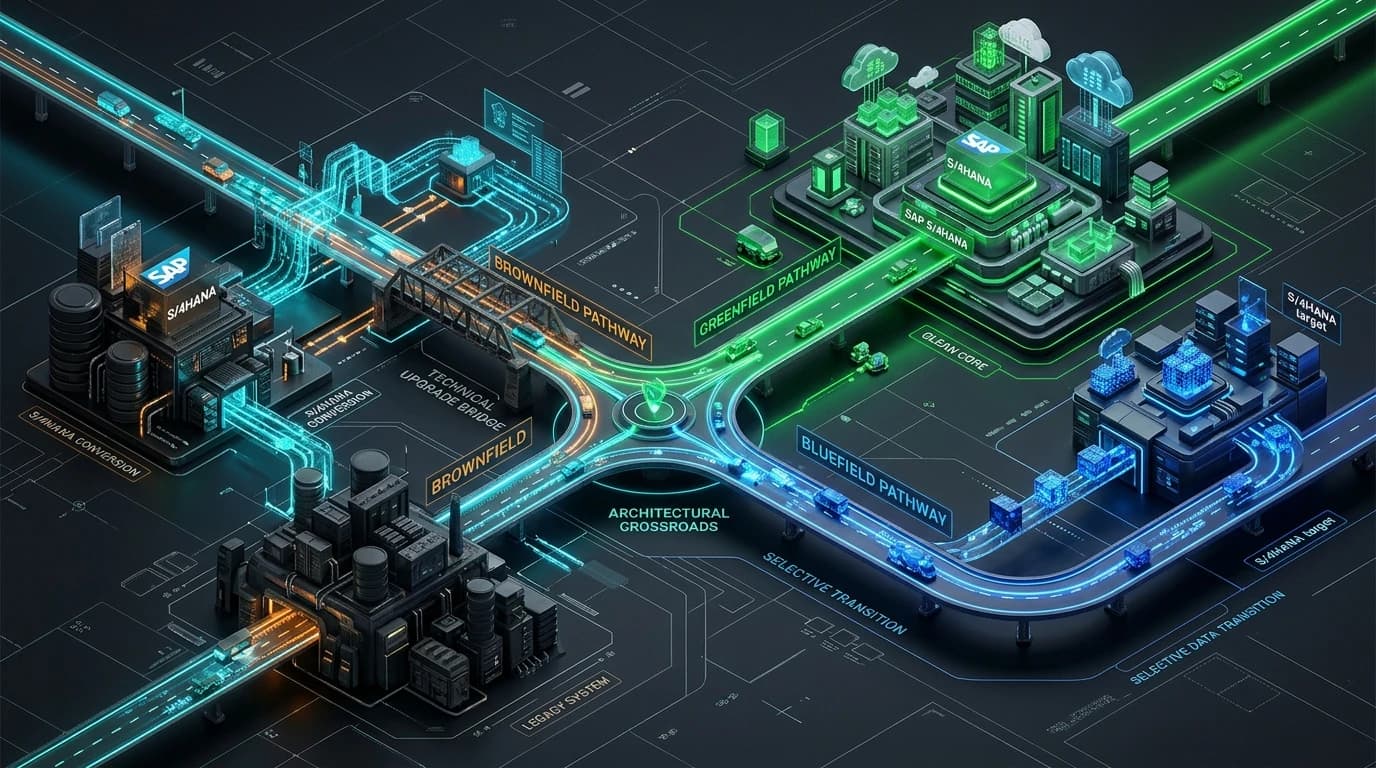
SAP S/4HANA Migration: Greenfield vs. Brownfield vs. Bluefield
With SAP’s formal end-of-mainstream-support deadline for SAP ECC 6.0 approaching in 2027 (with extended maintenance running through 2030), thousands of enterprises worldwide face the single most consequential IT infrastructure decision of the decade:
How should an organization transition its core enterprise processes to SAP S/4HANA without disrupting critical supply chains, triggering unmanageable cutover downtime, or ballooning implementation budgets?
There is no universal answer. A global pharmaceutical corporation with 20 years of legacy custom ABAP modifications has vastly different requirements than a mid-market manufacturing firm looking to shed legacy operational debt.
In this guide, we analyze the three primary transformation pathways—Greenfield (New Implementation), Brownfield (System Conversion), and Bluefield (Selective Data Transition)—evaluating their real-world trade-offs across data migration, custom code remediation, business change management, and long-term total cost of ownership (TCO).
The Three Migration Pathways at a Glance
Before examining each methodology in detail, let us establish their fundamental definitions:
┌────────────────────────────────────────────────────────────────────────┐
│                        SAP S/4HANA TRANSFORMATION                      │
└────────────────────────────────────────────────────────────────────────┘
          │                                 │                            │
          ▼                                 ▼                            ▼
┌──────────────────┐              ┌──────────────────┐         ┌──────────────────┐
│    GREENFIELD    │              │    BROWNFIELD    │         │    BLUEFIELD     │
│   (New System)   │              │ (Conversion/SUM) │         │ (Selective Data) │
├──────────────────┤              ├──────────────────┤         ├──────────────────┤
│ Clean slate      │              │ Preserve legacy  │         │ Shell creation   │
│ Standard best    │              │ Keep all history │         │ Split/merge orgs │
│ practices        │              │ Fast timeline    │         │ Near-zero        │
│ High business    │              │ Technical debt   │         │ downtime         │
│ change impact    │              │ carried forward  │         │ Tooling required │
└──────────────────┘              └──────────────────┘         └──────────────────┘
1. Greenfield Approach: New Implementation
The Greenfield approach treats the transition as a brand-new software installation. The legacy ECC system remains active strictly as an historical reference archive, while a fresh S/4HANA instance (either on-premise, private cloud, or public cloud) is configured from ground zero.
When Does Greenfield Make Sense?
- High Technical Debt: Over 40% of the enterprise's ECC landscape consists of custom Z-programs, user exits, and obsolete modifications that are no longer understood or maintained.
- Outdated Business Blueprints: The existing ERP setup was designed in the late 1990s or early 2000s and reflects business divisions that have since merged, dissolved, or pivoted.
- Commitment to "Clean Core": The organization wants to adhere strictly to SAP Clean Core governance, using standard APIs and SAP Business Technology Platform (BTP) for extensions.
- Public Cloud Adoption: Organizations migrating to SAP S/4HANA Cloud Public Edition must adopt a Greenfield approach, as direct in-place conversion is technically impossible.
Advantages of Greenfield:
- Zero Legacy Baggage: Legacy bad data, inconsistent chart of accounts, and broken customizing tables are permanently abandoned.
- Standardization: Forces business units to adopt modern SAP Best Practices and standard Fiori business roles instead of defending legacy custom screens.
- Optimized Data Footprint: Only active master data and open transaction items (open purchase orders, open AP/AR items, current inventory balances) are migrated, resulting in a lean, high-performance in-memory database footprint.
Disadvantages of Greenfield:
- Substantial Change Management: Users accustomed to 15-year-old custom SAP GUI screens must be retrained entirely on standard SAP Fiori apps and redesigned processes.
- Loss of Historical In-System Reporting: Because historical closed transactions remain in the retired ECC database or cold cloud storage, historical trend analysis requires unified data warehousing (e.g., SAP Datasphere or Snowflake).
- Higher Initial Capital Expenditure: Greenfield requires a complete analysis, design, build, and test lifecycle, typically requiring 12 to 24 months.
2. Brownfield Approach: System Conversion
The Brownfield methodology—formally designated by SAP as System Conversion—is an in-place technical upgrade of an existing SAP ECC system into SAP S/4HANA. Using the Software Update Manager (SUM) equipped with the Database Migration Option (DMO), the database is migrated to SAP HANA, data structures are converted to the Universal Journal (ACDOCA), and legacy tables (BSIS, BSAS, BSIK, BSAK) are converted into compatibility views.
When Does Brownfield Make Sense?
- Modern, Well-Maintained ECC Core: The current ECC instance is running ECC 6.0 EHP 7 or 8 on Unicode, with cleanly documented custom code and a chart of accounts that still supports corporate strategy.
- Need for Complete Historical Ledger Data: Legal or regulatory requirements mandate 10+ years of audit-compliant transaction history directly accessible within the active ERP database.
- Budget and Timeline Constraints: The business requires the fastest, lowest-cost pathway to reach S/4HANA compliance before the 2027 maintenance cliff.
Advantages of Brownfield:
- Preservation of Business Processes: Core company codes, purchasing workflows, and operational configurations remain intact.
- Minimal Disruption to End Users: Employees continue executing familiar business tasks with minimal change shock.
- Shorter Execution Window: Typical Brownfield conversions take between 6 and 9 months—substantially faster than a full Greenfield implementation.
Disadvantages of Brownfield:
- Carrying Forward Historical Inefficiencies: Any poorly structured master data, unmaintained vendor records, or redundant custom tables are carried directly into the new S/4HANA database.
- Mandatory Technical Prerequisites: All legacy customers and vendors must be converted to the Business Partner (BP) and Customer-Vendor Integration (CVI) model before the conversion starts. If CVI synchronization fails, SUM halts entirely.
- Substantial Custom Code Remediation: Every legacy Z-report that queries deprecated aggregate tables (such as
GLT0,KNC1,LFC1,VBRK) must be adapted using the ABAP Test Cockpit (ATC).
3. Bluefield Approach: Selective Data Transition
For large enterprise conglomerates, neither pure Greenfield nor pure Brownfield provides an optimal fit. Greenfield discards too much valuable history; Brownfield drags along too much obsolete clutter.
This led to the emergence of the Bluefield approach, championed by specialized SAP partners and formalized by the SAP Data Transformation Alliance.
In a Bluefield migration:
- A fresh target S/4HANA environment is established using an empty "shell copy" of the production ECC system (preserving custom configuration and approved Z-code, but leaving all transaction data behind).
- Advanced data transformation tools (such as SAP Landscape Transformation - SLT) extract and cleanse selected historical data.
- Companies can selectively migrate the last 2 to 5 years of historical financial and logistical documents while purging obsolete legal entities.
- Organizations can split corporate entities, merge multiple ERP instances into one, or harmonize their global Chart of Accounts simultaneously during the cutover.
Comparative Decision Matrix
| Evaluation Criteria | Greenfield (New) | Brownfield (Conversion) | Bluefield (Selective) |
|---|---|---|---|
| Average Project Timeline | 12 – 24 Months | 6 – 10 Months | 9 – 14 Months |
| Historical Data Retention | Open balances only | 100% of all history | Selected years (e.g., 2–5 yrs) |
| Custom Code Retained | Zero (rebuild clean) | All adapted Z-code | Selected high-value Z-code |
| Business Process Redesign | Maximum / Modernized | Minimal / Preserved | High / Selective |
| Cutover Business Downtime | Standard weekend | High (large data volumes) | Near-Zero Downtime (NZDT) |
| Change Management Effort | Very High | Low to Medium | Medium |
| Long-Term Agility | Highest (Clean Core) | Lower (Legacy Debt) | High |
How to Decide: The 5-Question Architectural Filter
If you are leading an enterprise roadmap or advising clients as an SAP architect, use this 5-question filter to determine the recommended strategy:
Question 1: Does the current ECC system support the next 10 years of business growth?
If the answer is No—because business models have shifted from discrete manufacturing to recurring subscriptions, or because company codes are fragmented beyond repair—the only sustainable route is Greenfield.
Question 2: Is the enterprise moving to SAP S/4HANA Cloud Public Edition?
Public Cloud multitenant architecture does not support system conversion. If public cloud is chosen, Greenfield is mandatory.
Question 3: What is the maximum acceptable cutover downtime?
For 24/7 global supply chains where a plant cannot shut down for more than 12 to 18 hours, a massive multi-terabyte Brownfield database conversion may exceed the downtime budget. In such cases, Bluefield with Near-Zero Downtime (NZDT) technology is required.
Question 4: How clean is the current custom code repository?
Run the ABAP Test Cockpit (ATC) with the S/4HANA readiness check variant. If more than 60% of custom objects require extensive manual code remediation, rewriting essential extensions on BTP in a Greenfield project is frequently more cost-effective than patching legacy ABAP.
Question 5: What is the primary objective of the executive sponsor?
- If the CFO wants immediate compliance at lowest cost before 2027: Choose Brownfield.
- If the CEO wants business process modernization, AI integration, and total digital agility: Choose Greenfield.
Frequently Asked Questions (FAQ)
What is the primary difference between Greenfield and Brownfield in SAP S/4HANA?
Greenfield is a brand-new implementation where processes and data structures are built from scratch, whereas Brownfield (System Conversion) converts an existing SAP ECC system into S/4HANA in-place, preserving configuration and transactional history.
When should an enterprise choose Selective Data Transition (Bluefield)?
Selective Data Transition is best suited for complex multi-system landscapes, mergers, or carve-outs where an enterprise wants to redesign business processes like Greenfield while selectively migrating open items and historical data.
What happens to custom Z-programs in a Brownfield migration?
In a Brownfield migration, all custom ABAP programs must be scanned using the Custom Code Migration Worklist in ADT and SAP Readiness Check. Obsolete tables (e.g. BSEG, BSIS, KONV) must be remediated to work with S/4HANA CDS views and the Universal Journal.
How long does a typical SAP S/4HANA migration take?
A Brownfield conversion typically spans 6 to 9 months for mid-sized enterprises, while a global Greenfield transformation commonly spans 12 to 24 months due to process redesign and change management.
Conclusion
Migrating to SAP S/4HANA is not merely a database upgrade; it is an architectural modernization of the enterprise operating backbone. Organizations that treat it as a routine technical patch often end up with a high-cost database running legacy processes, while those who strategically evaluate Greenfield, Brownfield, and Bluefield options unlock true operational efficiency.
To understand how modern data models simplify reporting on S/4HANA, continue reading our architectural breakdown on SAP S/4HANA vs ECC Architectural Differences and explore our deep-dive into SAP Clean Core Strategy.
Ready to Accelerate Your Career with SAP Architecture?
Stop struggling with fragmented tutorials. Get trained personally by Akshay Kumar (6+ years experience, 500+ placed professionals) with real-time S/4HANA server access, business blueprint scenarios, and 100% interview preparation.

Related Tutorials & Articles
Continue learning with more insights from ERP Academy experts.

Why SAP Clean Core Is Making or Breaking S/4HANA Migrations (And What Developers Need to Know)
Tired of hearing 'Keep the Core Clean' buzzwords? Here is an architect's practical guide to what SAP Clean Core actually means, why legacy Z-programs choke upgrades, ABAP Cloud vs Classic ABAP, and how to build cloud-ready extensions on BTP.
Read Guide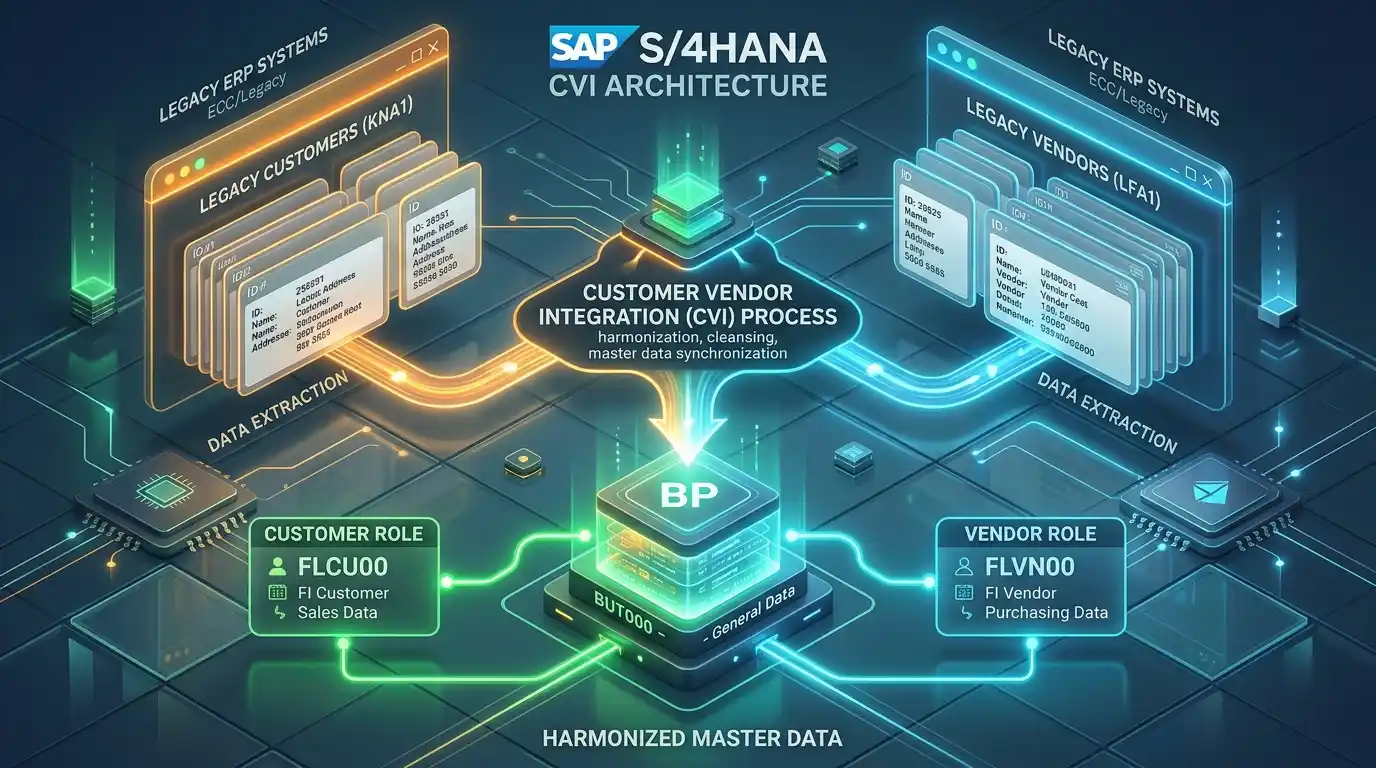
SAP Business Partner (BP) & CVI Customer-Vendor Integration in S/4HANA: Complete T-Code BP Guide
Master SAP Business Partner (BP) and Customer-Vendor Integration (CVI) in S/4HANA. Complete walkthrough of BP roles (FLVN00, FLVN01, FLCU00, FLCU01), grouping and number range synchronization, MDS_LOAD_COCKPIT, and how to fix common CVI sync errors.
Read Guide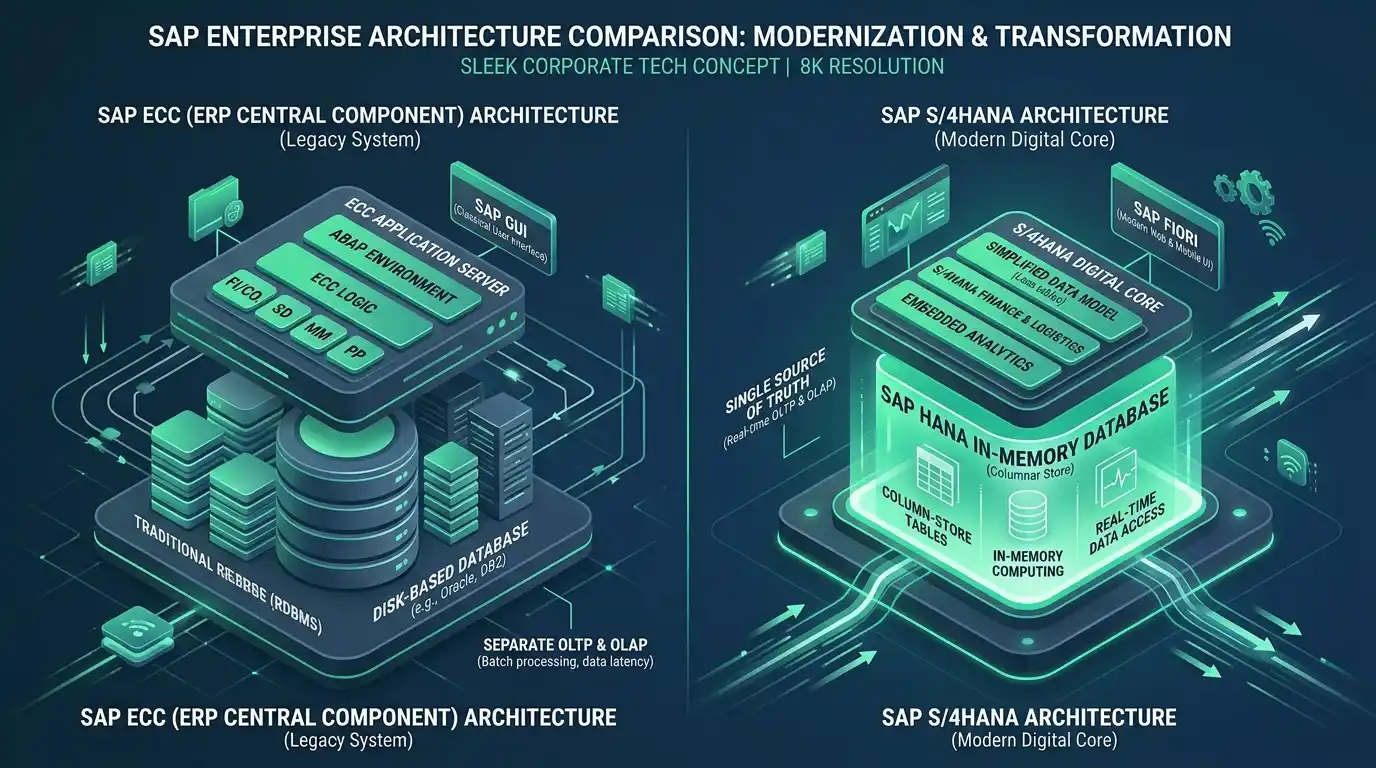
SAP S/4HANA vs SAP ECC 6.0: 12 Critical Differences Every Consultant Must Know (2025/2026 Guide)
Still confused about what actually changes between SAP ECC and S/4HANA? Here is a definitive mentor-backed breakdown of the 12 core differences—from the Universal Journal (ACDOCA) and Business Partner (BP) model to Sourcing & Procurement simplifications and Fiori UX.
Read Guide