
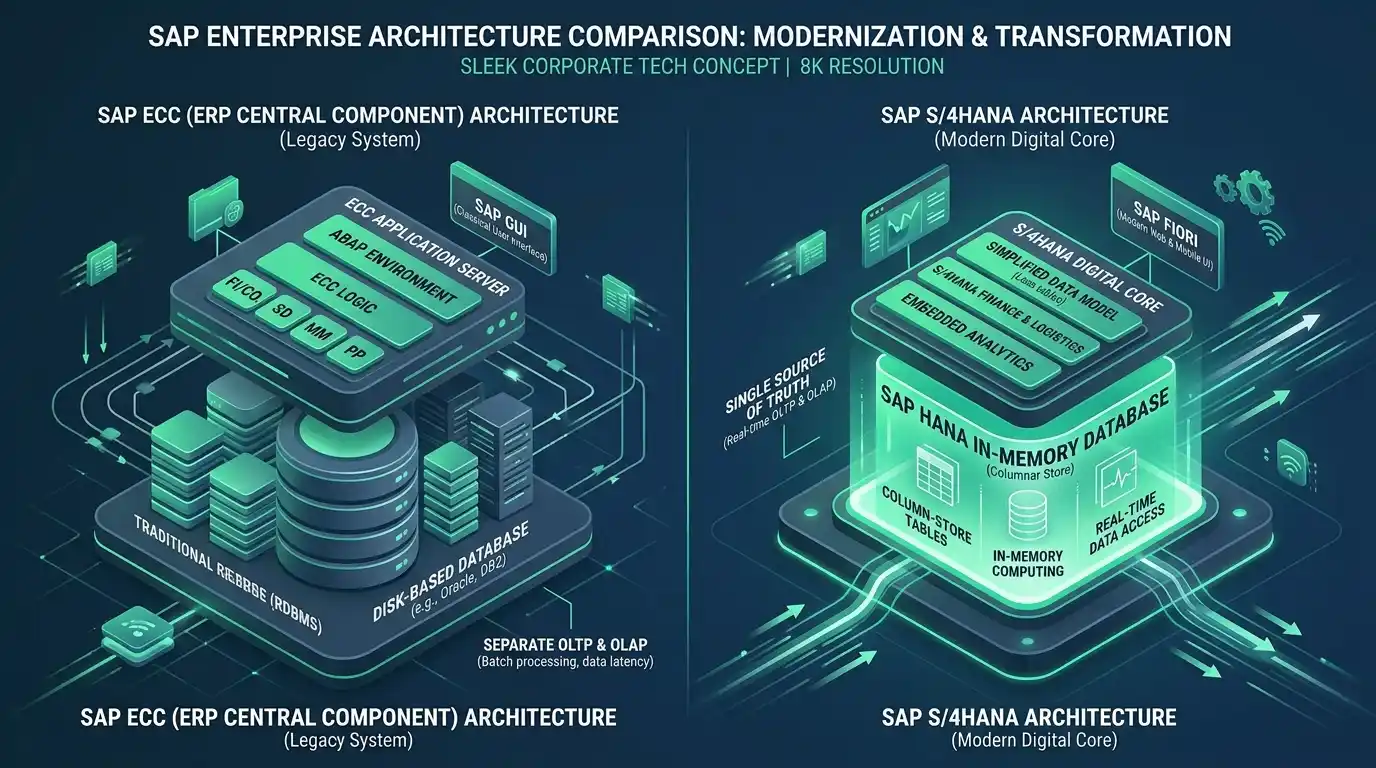
SAP S/4HANA vs SAP ECC 6.0: The Complete Technical & Functional Guide
With SAP's official mainstream maintenance deadline for SAP ECC 6.0 arriving at the end of 2027, enterprise IT departments and SAP consulting firms across India and globally are racing to migrate to SAP S/4HANA.
Yet, during student mentoring sessions and corporate interviews at ERP Academy, one question arises more frequently than any other:
"What actually changes when an organization moves from SAP ECC 6.0 to SAP S/4HANA? Is it just a database upgrade, or does it fundamentally rewrite how functional consultants work?"
The short answer: It is an entirely re-architected digital core.
In this exhaustive guide, we dissect the 12 most impactful differences between SAP ECC and SAP S/4HANA across database design, functional modules (MM, FICO, SD), data structures, and user interfaces.
At a Glance: Architecture Comparison Matrix
| Architectural Dimension | SAP ECC 6.0 (Legacy) | SAP S/4HANA (Current & Future) | Real-World Impact |
|---|---|---|---|
| Underlying Database | AnyDB (Oracle, MS SQL, DB2, MaxDB) | SAP HANA (Strictly In-Memory Columnar) | 100x to 1,000x faster transaction queries & analytics |
| Finance Table Architecture | Fragmented tables (BKPF, BSEG, BSIS, BSAS, COEP) | Single Universal Journal table (ACDOCA) | Zero reconciliation needed between FI and CO |
| Vendor & Customer Master | Separate T-codes (XK01, FK01, XD01, FD01) | Centralized Business Partner (T-Code: BP) | Unified customer/vendor entities via CVI |
| Material Number Field Length | 18 Characters | 40 Characters (Extended Material Number) | Eliminates cryptic abbreviations for complex manufactured parts |
| Material Requirements Planning | Batch job MRP runs overnight (MD01, MD02) | Real-time MRP Live on HANA (MD01N) | Planners run MRP in minutes instead of 8 hours overnight |
| Inventory Management Data Model | Redundant aggregates & history tables (MKPF, MSEG, MBEW) | Single document table (MATDOC) | Eliminates table locking; true real-time inventory valuations |
| User Experience (UX) | Traditional SAP GUI (SAP Logon) | SAP Fiori (Web-based role-centric responsive apps) | Clean, intuitive mobile-ready dashboards for business users |
| Foreign Trade Integration | Native Foreign Trade functionality in ECC | Replaced by SAP Global Trade Services (GTS) | Advanced compliance and customs declaration automation |
| Credit Management | Standard FI-AR Credit Management (FD32) | SAP Financial Supply Chain Management (FSCM-CR) | Automated scoring, rule-based credit checks & workflows |
| Output Management | NAST Table message control | BRFplus (Business Rule Framework Plus) | Modern omni-channel output (Email, PDF, Print, XML) |
| Pricing Table Optimization | Classical KONV cluster table | PRCD_ELEMENTS transparent table | Massive speedup in order & invoice condition calculations |
| Extensibility Paradigm | Direct modifications (Z-programs, User Exits) | SAP Clean Core Strategy (ABAP Cloud, BTP Extensions) | Zero-friction upgrades and seamless cloud compatibility |
Deep Dive: The 12 Critical Architectural Differences
1. The Database Shift: AnyDB vs SAP In-Memory HANA
In SAP ECC, the application layer was built to remain database-agnostic. Organizations ran ECC on Oracle, Microsoft SQL Server, IBM DB2, or SAP Sybase. Because traditional relational databases stored data row-by-row on spinning mechanical disks, SAP ECC relied heavily on pre-calculated aggregates and index tables to deliver acceptable reporting speeds.
In SAP S/4HANA: S/4HANA only runs on the SAP HANA database. HANA stores data entirely in volatile memory (RAM) utilizing columnar storage and advanced data dictionary compression.
- Aggregates and index tables have been completely dropped.
- Reports calculate sums and averages on millions of transactional rows in sub-seconds.
- OLTP (transactions) and OLAP (analytics) run concurrently inside the exact same system without data replication.
2. The Universal Journal (ACDOCA): The End of FI-CO Reconciliation
In SAP ECC 6.0, Financial Accounting (FI) and Management Accounting / Controlling (CO) lived in separate data silos:
- FI posted to General Ledger header
BKPFand line itemBSEG. - CO posted cost centers and internal orders to
COEPandCOSP. - Period-end closing required tedious reconciliation runs (T-Code
KALC/ Reconciliation Ledger).
In SAP S/4HANA:
SAP unified all financial records into a single mega-table: ACDOCA (Universal Journal).
Every line item posted contains:
- General Ledger Account
- Cost Center & Profit Center
- Segment & Functional Area
- Asset Number, Material ID & Customer/Vendor Partner
There is zero reconciliation required between General Ledger and Cost Accounting because they write to the exact same table simultaneously. Period close duration drops from days to hours.
3. Business Partner (BP) Approach via Customer-Vendor Integration (CVI)
In SAP ECC, functional consultants used separate transaction codes:
XK01/XK02for Vendor Master (MM)XD01/XD02for Customer Master (SD)FD01/FK01for Company Code specific views (FI)
If a partner company acted as both a vendor (supplier) and a customer (client), consultants had to create two separate records and manually link them.
In SAP S/4HANA:
Transactions XK01, XK02, XD01, and XD02 are completely obsolete. Entering them immediately redirects to:
T-Code:
BP(Business Partner)
In S/4HANA:
- Every supplier, customer, person, or organization is first created as a single Business Partner.
- Role
FLVN00assigns Financial Supplier views. - Role
FLVN01assigns MM Purchasing views. - Role
FLCU00&FLCU01assign Customer FI & Sales views.
Master data redundancy is eliminated, and global legal hierarchies are simplified.
4. Simplified Sourcing & Procurement: The MATDOC Revolution
In SAP ECC, every inventory movement (goods receipt, goods issue, stock transfer) wrote to multiple tables:
MKPF(Material Document Header)MSEG(Material Document Line Items)MARC,MARD,MBEW(Stock values and history tables)
This heavy aggregation caused frequent table locking when multiple users posted receipts simultaneously for the same plant and storage location.
In SAP S/4HANA:
All historical tables are replaced by MATDOC (Material Document).
- Material documents are stored as immutable, single-line items.
- Stock quantities and valuations are computed dynamically on the fly by HANA column engines.
- Throughput for warehouse goods receipts (
MIGO) increases exponentially without deadlocks.
5. MRP Live (MD01N): Real-Time Supply Chain Planning
In ECC, Material Requirements Planning (MRP) was so computationally demanding that enterprises ran MD01 as an overnight batch job spanning 4 to 8 hours. If demand spiked during the day, production planners had to wait until the next morning to see updated procurement proposals.
In SAP S/4HANA:
MRP Live (MD01N) executes directly in the HANA database memory utilizing optimized SQL push-down logic.
- MRP calculations take 3 to 15 minutes instead of 6 hours.
- Planners can run MRP multiple times daily during business hours.
- Cross-plant planning and vendor constraint simulations happen in real time.
6. Extended Material Number: From 18 to 40 Characters
In SAP ECC, the material master field MATNR had a hard limit of 18 characters. Automotive, aerospace, and high-tech manufacturing companies with complex part serial numbers had to develop complex custom concatenation logic or Z-tables to track parts.
In SAP S/4HANA:
SAP expanded MATNR to 40 characters. This is configurable in customizing (T-Code OMSL), allowing global supply chains to store exact manufacturer part numbers without custom workarounds.
7. Modern User Interface: SAP Fiori vs Legacy SAP GUI
While classic SAP GUI (SAP Logon) with its blue menus and T-code bar is still available in S/4HANA, the primary, strategic user interface is SAP Fiori.
- SAP Fiori Apps are web-based, HTML5-powered, and responsive across desktop, tablet, and mobile devices.
- Instead of memorizing 50 cryptic transaction codes, users see role-based analytical tiles displaying live KPIs (e.g., "Overdue Purchase Orders", "Open Vendor Invoices", "Stock Below Safety Threshold").
- Embedded search allows users to find purchase orders, materials, and contracts like a Google search engine.
8. Output Management: BRFplus Replaces NAST
In SAP ECC, purchase order and billing output determination was governed by the decades-old NAST table and condition records (MN04 / VV11). Modifying print forms or emailing purchase orders to vendors required custom ABAP code in user exits or SAPscript/SmartForms.
In SAP S/4HANA: SAP introduced BRFplus (Business Rule Framework Plus) for output management:
- Centralized decision tables define print, email, EDI, and XML dispatching rules.
- Fully compatible with cloud email relays and Adobe Document Services (ADS).
- Business analysts can modify output routing rules without requesting developer code changes.
9. Credit Management: Migration to FSCM
In ECC, credit limit checks were maintained directly within Sales & Distribution and FI-AR via T-Code FD32.
In S/4HANA: Credit checks are managed by SAP Financial Supply Chain Management (FSCM Credit Management):
- Automated real-time credit scoring integrated with credit rating agencies (Dun & Bradstreet, Experian).
- Automated credit limit workflows that dynamically adjust terms based on customer payment history.
10. Valuation Method: Material Ledger is Strictly Mandatory
In SAP ECC, activating the Material Ledger was optional. Many small-to-medium businesses opted out because of performance penalties.
In SAP S/4HANA: Material Ledger activation is 100% mandatory.
- S/4HANA requires Material Ledger to enable parallel inventory valuations across multiple accounting currencies (e.g., Group Currency, Hard Currency, Index Currency).
- Actual costing (
ML) can still be toggled, but the ledger itself is non-negotiable.
11. Vendor Rebates: Settlement Management (Condition Contracts)
In ECC, vendor rebate agreements were configured through standard Rebate Agreements (VBO1 / MEB1).
In S/4HANA:
Classic rebate processing is eliminated and superseded by Settlement Management (Condition Contracts via T-Code WCOCO). This provides a unified engine for both customer rebates and supplier chargebacks.
12. Extensibility & The "Clean Core" Strategy
In SAP ECC, developers freely modified standard SAP code using modifications, implicit enhancements, and Z-programs directly inside the core application. Over 15 years, these custom programs accumulated immense technical debt, turning upgrade projects into multi-million dollar nightmares.
In SAP S/4HANA: SAP strictly enforces the Clean Core paradigm:
- Custom code is developed using ABAP Cloud with released public APIs (
RAP- RESTful Application Programming Model). - Complex custom logic is hosted on the SAP Business Technology Platform (BTP).
- System updates and cloud release upgrades install smoothly without breaking custom enterprise workflows.
What Does This Mean for Your SAP Career in 2025–2026?
If you are an aspiring consultant or an existing ECC professional in India, working only with legacy ECC transaction codes makes you vulnerable.
Enterprise job descriptions from top employers like Deloitte, Accenture, PwC, TCS, Infosys, and Wipro now explicitly demand:
- Hands-on experience with S/4HANA 2023 / 2025 interfaces.
- Complete fluency with Business Partner (BP) CVI configuration.
- Thorough understanding of the Universal Journal (
ACDOCA) orMATDOCsimplifications. - Experience testing and deploying SAP Fiori apps.
At ERP Academy, our comprehensive courses in SAP MM Training, SAP HANA, and SAP FI Training are taught on live SAP S/4HANA enterprise servers, ensuring you master both the theoretical distinctions and the real-time configuration steps required to excel in consultant interviews.
Frequently Asked Questions (FAQ)
What is the biggest difference between SAP ECC and SAP S/4HANA?
The biggest difference is the architectural redesign: S/4HANA runs exclusively on the SAP HANA in-memory columnar database and unifies transactional tables into single sources of truth, such as the Universal Journal (ACDOCA) in Finance and MATDOC in Materials Management, replacing dozens of legacy aggregate tables.
Can SAP S/4HANA run on Oracle or Microsoft SQL Server?
No. SAP ECC could run on any database (Oracle, MS SQL, DB2), but SAP S/4HANA is strictly engineered to run solely on the SAP HANA in-memory database engine.
Are transaction codes like XK01, XD01, and MB01 still available in S/4HANA?
No. Legacy vendor and customer creation codes like XK01 and XD01 are obsolete and replaced by centralized Business Partner transaction BP. Legacy inventory movement codes like MB01 and MB11 are replaced by unified transaction MIGO.
Why is SAP moving away from ECC 6.0 by 2027?
SAP is ending mainstream support for ECC 6.0 to focus its product engineering entirely on S/4HANA Cloud and On-Premise editions, helping modern enterprises adopt artificial intelligence, real-time analytics, and clean core cloud-ready extensions.
How should a beginner start learning SAP S/4HANA?
Beginners should first understand core enterprise business processes (Procurement in MM, Financial Reporting in FI, or In-Memory Modeling in HANA), practice on live S/4HANA system environments, and follow structured roadmaps led by experienced enterprise mentors. Check out our SAP FICO Career Roadmap and SAP MM Beginners Guide for step-by-step guidance.
Ready to Accelerate Your Career with SAP Architecture?
Stop struggling with fragmented tutorials. Get trained personally by Akshay Kumar (6+ years experience, 500+ placed professionals) with real-time S/4HANA server access, business blueprint scenarios, and 100% interview preparation.

Related Tutorials & Articles
Continue learning with more insights from ERP Academy experts.
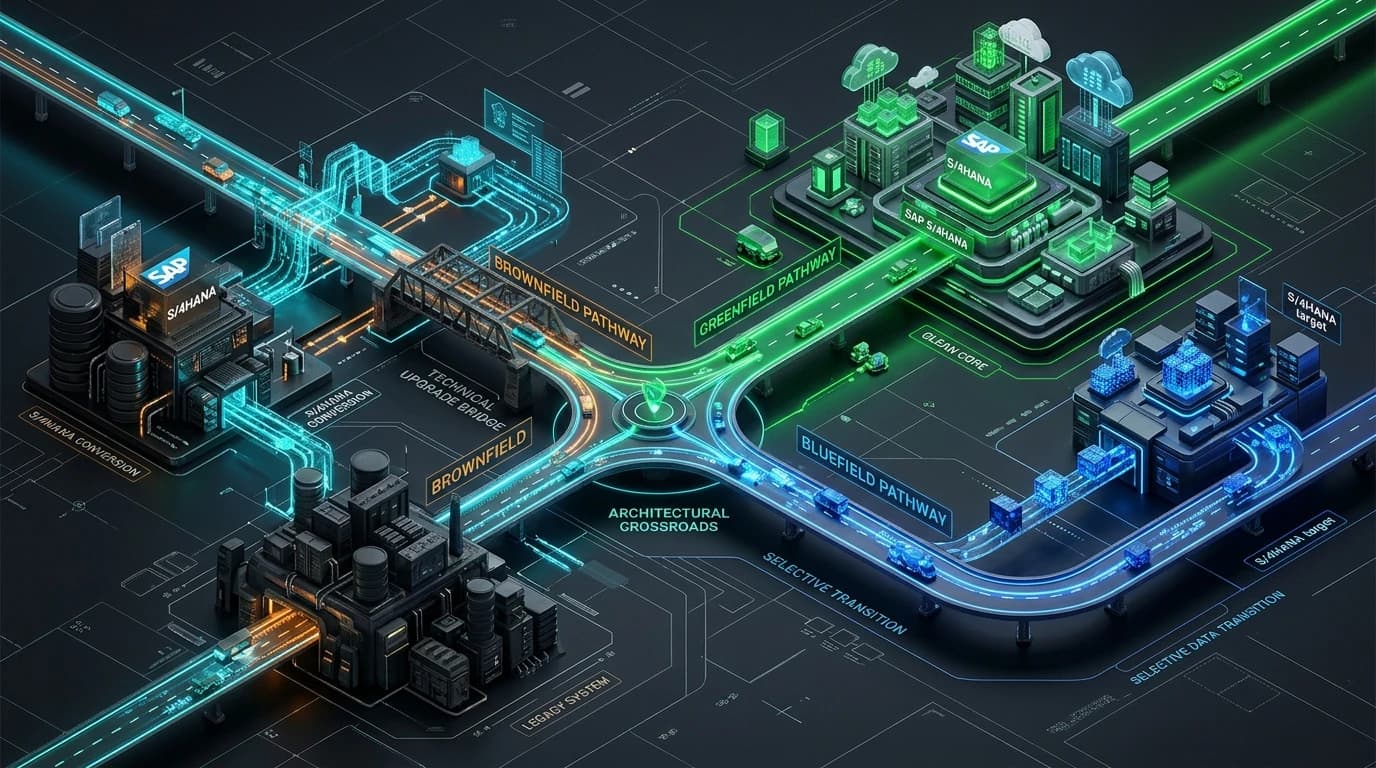
SAP S/4HANA Greenfield vs Brownfield: Decision Matrix, Architecture & Migration Roadmap
Compare SAP S/4HANA Greenfield, Brownfield (System Conversion), and Selective Data Transition. Full architectural decision matrix covering Clean Core strategy, custom code remediation, downtime constraints, and cost implications.
Read Guide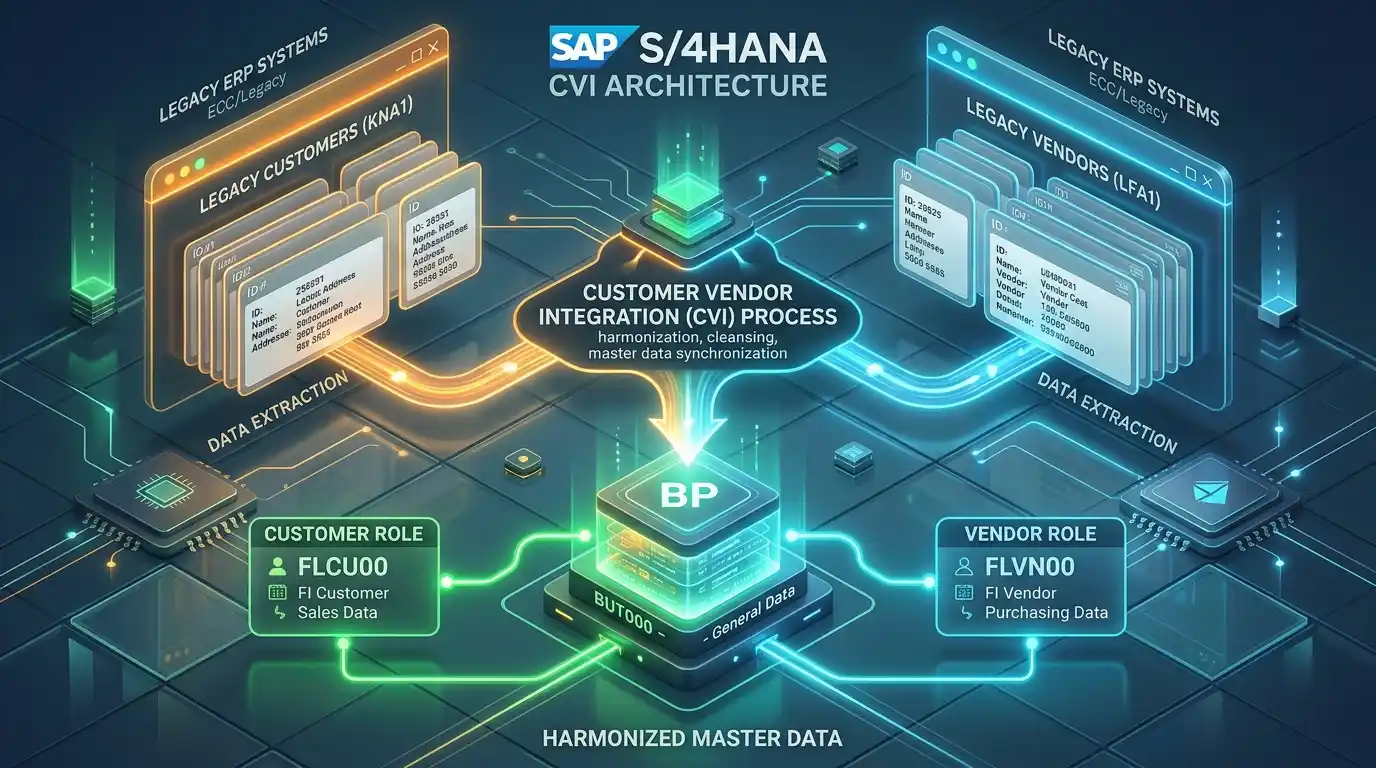
SAP Business Partner (BP) & CVI Customer-Vendor Integration in S/4HANA: Complete T-Code BP Guide
Master SAP Business Partner (BP) and Customer-Vendor Integration (CVI) in S/4HANA. Complete walkthrough of BP roles (FLVN00, FLVN01, FLCU00, FLCU01), grouping and number range synchronization, MDS_LOAD_COCKPIT, and how to fix common CVI sync errors.
Read Guide
Why SAP Clean Core Is Making or Breaking S/4HANA Migrations (And What Developers Need to Know)
Tired of hearing 'Keep the Core Clean' buzzwords? Here is an architect's practical guide to what SAP Clean Core actually means, why legacy Z-programs choke upgrades, ABAP Cloud vs Classic ABAP, and how to build cloud-ready extensions on BTP.
Read Guide