
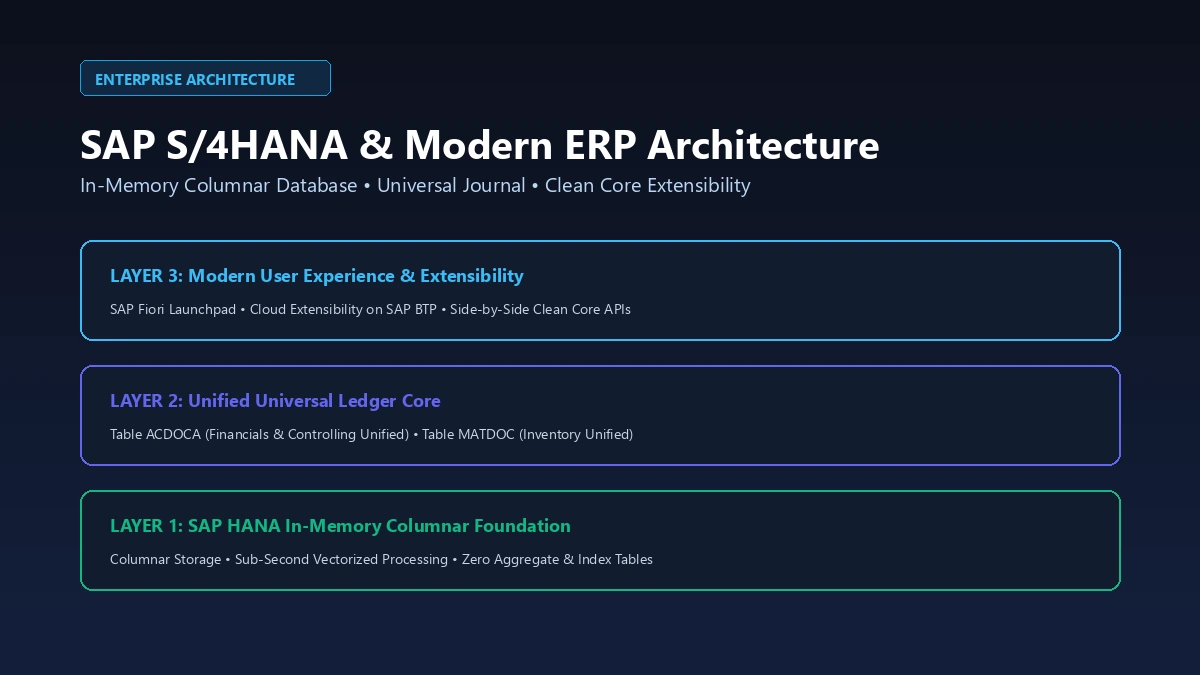
SAP S/4HANA and Modern ERP: Architecture, Business Processes, and Skills Professionals Need
For nearly three decades, enterprise computing was defined by relational database architectures engineered in the 1980s and 1990s. Traditional ERP suites—such as SAP R/3 and SAP ERP Central Component (ECC 6.0)—were constrained by the physics of spinning hard disks, row-based relational databases (Oracle, DB2, MS SQL Server), and rigid table architectures designed to minimize storage footprints.
To run financial balance sheets or material requirements planning across a global corporation, legacy systems relied on complex webs of aggregate tables (GLT0, KNC1, LFC1), index tables (BSIS, BSAS, BSIK, BSAK), and nightly batch jobs that locked operational records for hours.
With the release of SAP S/4HANA (SAP Business Suite 4 SAP HANA), enterprise computing underwent a once-in-a-generation architectural revolution. By combining high-speed in-memory columnar computing with radical data model simplification, modern ERP shifted from a retrospective historical recording system into an intelligent, real-time operational engine.
In this comprehensive architectural guide, we unpack the structural foundation of SAP S/4HANA, examine the simplified data model, explore the Clean Core extensibility paradigm, and map out the exact technical and functional competencies enterprise professionals need in 2026.
The Architectural Foundation: In-Memory Columnar Database
To understand why SAP S/4HANA fundamentally outperforms legacy ERP systems, you must examine how data is physically arranged and accessed in memory:
[Traditional Disk-Based Row Store]
Disk Storage (Slow I/O) ──> Heavy Buffer Cache ──> Row-by-Row Search ──> CPU Execution

[Modern In-Memory Columnar Store (HANA)]
DRAM Memory (Sub-Nanosecond) ──> Column-Based Scan ──> Vectorized Processing ──> Real-Time Aggregation
| Dimension | Legacy SAP ECC 6.0 (AnyDB) | Modern SAP S/4HANA (SAP HANA) |
|---|---|---|
| Primary Data Storage | Traditional spinning hard drives or standard SSDs | Direct Dynamic RAM (In-Memory Columnar Database) |
| Data Organization | Row-based tables (all attributes of a single row stored contiguously) | Column-based tables (values of a single attribute stored together in memory) |
| Data Redundancy | Extensive redundant aggregate and index tables to enable reporting | Zero aggregate tables. All reporting aggregates calculated on-the-fly |
| Processing Paradigm | Data-to-Code: Heavy transactional records moved to application server for calculation | Code-to-Data (Pushdown): Aggregations and calculations executed natively inside the HANA engine |
| User Experience | Traditional SAP GUI desktop application (Transaction Codes) | Modern SAP Fiori HTML5/UI5 responsive web apps across all devices |
Why Columnar Storage Changes Everything for Enterprise ERP
In transactional business operations, a table like ACDOCA or MATDOC might contain 150 to 300 columns, but an analytical query (e.g., "Total procurement expenditure by plant in Q3") only requests 4 columns (Plant, MaterialGroup, PostingDate, Amount).
- In a traditional row store, the database must read every single byte of every single row from disk into memory, discarding 98% of the data it just fetched.
- In a column store, the HANA engine reads only the requested column vectors, completely ignoring the other 296 columns. Combined with dictionary compression and CPU cache line vectorization, queries that previously took 45 minutes execute in less than 800 milliseconds.
The Great Table Simplification: ACDOCA & MATDOC
The single greatest functional innovation in S/4HANA is the elimination of fragmented module databases in favor of single, unified ledger architectures.
1. The Universal Journal: Table ACDOCA
In legacy ECC, financial transactions were split across multiple disconnected modules and tables:
- General Ledger lived in
BSEGandFAGLFLEXA. - Asset Accounting lived in
ANEPandANLP. - Cost Center and Internal Order controlling lived in
COEP. - Profitability Analysis lived in
CE1xxxxorCE4xxxx.
At the end of every financial period, accountants spent days executing reconciliation ledger jobs (KALC) just to balance Finance (FI) with Management Accounting (CO).
In SAP S/4HANA, all of these fragmented tables are replaced by a single universal foundation: The Universal Journal (Table ACDOCA).
- Every financial transaction, asset depreciation line, cost center assessment, and profitability segment is recorded as a single multi-dimensional line item.
- Reconciliation between FI and CO is eliminated by design, enabling instant, real-time P&L reporting at any second of the month.
2. The Universal Inventory Ledger: Table MATDOC
Similarly, in Materials Management and logistics:
- Legacy ECC fragmented inventory movements across header table
MKPF, line-item tableMSEG, and stock summary tablesMARCandMARD. - S/4HANA unifies all inventory movements into a single document:
MATDOC. - Eliminating stock table locks allows parallel goods receipts and inventory movements for the same material simultaneously, removing warehouse bottlenecks in high-volume e-commerce and retail facilities.
Modern Business Process Evolutions
S/4HANA does not merely accelerate database speeds; it redesigns fundamental business processes:
1. Business Partner (BP) Customer-Vendor Integration (CVI)
In legacy systems, vendors were created via XK01 (stored in LFA1) and customers via XD01 (stored in KNA1). If an entity was both a supplier and a buyer, data was duplicated and difficult to synchronize.
In S/4HANA:
- Transaction
BPreplaces all legacy customer/vendor creation screens. - A single legal entity (person or organization) is maintained as a unified Business Partner and assigned functional roles:
FLVN00(Vendor Financial),FLVN01(Vendor Purchasing),FLCU00(Customer Financial), andFLCU01(Customer Sales).
2. MRP Live (Material Requirements Planning in Real-Time)
In legacy ERP, running Material Requirements Planning across an entire multinational manufacturing footprint was so resource-intensive that it had to be scheduled as an overnight batch job (MD01).
With MRP Live (MD01N):
- The planning algorithm is pushed directly into the in-memory SAP HANA engine.
- Instead of waiting for overnight batch windows, plant planners execute real-time MRP calculations during live business hours, immediately seeing the impact of demand spikes or supply chain disruptions.
The Clean Core Paradigm: Keeping the Enterprise Upgrade-Ready
Over the past two decades, enterprises heavily customized their ECC systems by writing thousands of custom ABAP programs (Z-programs), user exits, and direct table modifications. When the time came to apply an upgrade or security patch, these un-governed modifications broke, turning routine software updates into expensive multi-month consulting nightmares.
In modern SAP S/4HANA and SAP BTP (Business Technology Platform), SAP enforces the Clean Core Strategy:
[Clean Core Architecture]
┌────────────────────────────────────────────────────────┐
│             Extensibility & Custom Apps                │
│       Side-by-Side on SAP BTP / In-App Developer       │
└───────────────────────────▲────────────────────────────┘
                            │ Released APIs / CDS Views
┌───────────────────────────┴────────────────────────────┐
│              SAP S/4HANA Standard Core                 │
│      Zero Modification of Standard SAP Source Code      │
└────────────────────────────────────────────────────────┘
- Strict Core Isolation: No developer is permitted to modify standard SAP source code or write direct SQL queries against internal application tables.
- Released Public APIs: All extensions must communicate through official, SAP-released APIs and Core Data Services (CDS Views).
- Side-by-Side Extensibility on SAP BTP: Custom business applications, portals, and third-party integrations run independently on the cloud via SAP Business Technology Platform, ensuring the underlying S/4HANA core can be upgraded seamlessly with zero regression breaks.
Modern Skill Matrix: What Enterprise Consultants Need in 2026
To thrive in the modern S/4HANA ecosystem, ERP consultants must evolve beyond classic legacy habits:
| Outdated Competency (Legacy ECC) | Modern Competency (SAP S/4HANA in 2026) |
|---|---|
| Writing complex classic Open SQL with nested loops | Building Core Data Services (CDS Views) with in-memory code pushdown |
| Navigating classical SAP GUI transaction trees exclusively | Designing intuitive user experiences on SAP Fiori Launchpad |
Classical vendor master maintenance (XK01 / FK01) | Business Partner (BP) synchronization and CVI customizing |
| Legacy reconciliation ledger runs between FI and CO | Leveraging the Universal Journal (ACDOCA) for real-time reporting |
Writing monolithic custom Z-reports modifying standard tables | Building cloud-ready extensions adhering to SAP Clean Core principles |
Frequently Asked Questions (FAQ)
What is the relationship between SAP HANA and SAP S/4HANA?
SAP HANA is the underlying in-memory columnar database and technological engine. SAP S/4HANA is the complete enterprise business software suite (covering finance, procurement, sales, supply chain, and manufacturing) written specifically to run natively on top of the SAP HANA database platform.
What is the difference between S/4HANA On-Premise and S/4HANA Cloud?
S/4HANA On-Premise (or Private Cloud) gives enterprises complete infrastructure control, custom code flexibility, and full SPRO customizing access. S/4HANA Cloud Public Edition is a multi-tenant SaaS offering managed directly by SAP, enforcing strict Clean Core guidelines and automated bi-annual innovation updates.
Can legacy ECC 6.0 data be converted directly into S/4HANA?
Yes. Enterprises can choose between Brownfield (System Conversion)—which converts an existing ECC system into S/4HANA in-place, migrating historical ledgers into ACDOCA—or Greenfield, which implements a brand-new S/4HANA environment with re-engineered business processes.
Conclusion & Architectural Next Steps
SAP S/4HANA represents more than an incremental software update; it is the modern architectural foundation for global business operations. Professionals who master in-memory modeling, the Universal Journal, and Clean Core extensibility position themselves at the very top of enterprise consulting compensation and career longevity.
Explore our architectural and technical learning tracks:
- SAP HANA In-Memory Modeling & Architecture Track
- SAP Clean Core Strategy in S/4HANA: Complete Guide
- SAP S/4HANA Greenfield vs Brownfield Migration Decision Matrix
- SAP CDS Views in S/4HANA: DDL Architecture & VDM Layers
Ready to Accelerate Your Career with Architecture?
Stop struggling with fragmented tutorials. Get trained personally by Akshay Kumar (6+ years experience, 500+ placed professionals) with real-time S/4HANA server access, business blueprint scenarios, and 100% interview preparation.

Related Tutorials & Articles
Continue learning with more insights from ERP Academy experts.

AI-Driven SAP S/4HANA Cloud Migration: Best Practices for 2024
Discover how generative AI is reshaping SAP S/4HANA migrations to the cloud, delivering faster go‑live times and smarter process automation. This guide outlines the latest strategies, tools, and real‑world success stories for enterprises in 2024.
Read Guide
Generative AI Revolution: Accelerating SAP S/4HANA Migration to the Cloud
Explore how generative AI is reshaping SAP S/4HANA cloud migration, delivering faster go‑live times and smarter process automation. Learn practical strategies and real‑world success stories that enterprise leaders can apply today.
Read Guide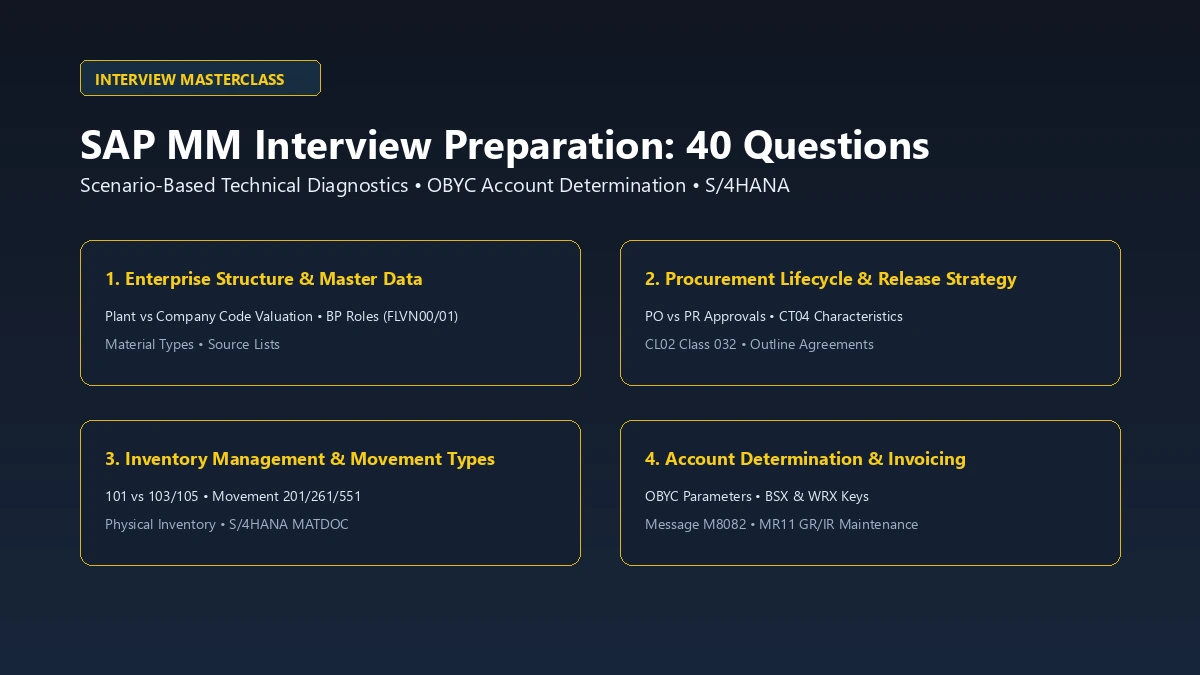
SAP MM Interview Preparation: 40 Practical, Scenario-Based Questions & Answers
Prepare for your SAP MM consultant interview with 40 real-world, scenario-based questions covering P2P, split valuation, physical inventory, PR release strategy, and OBYC integration.
Read Guide